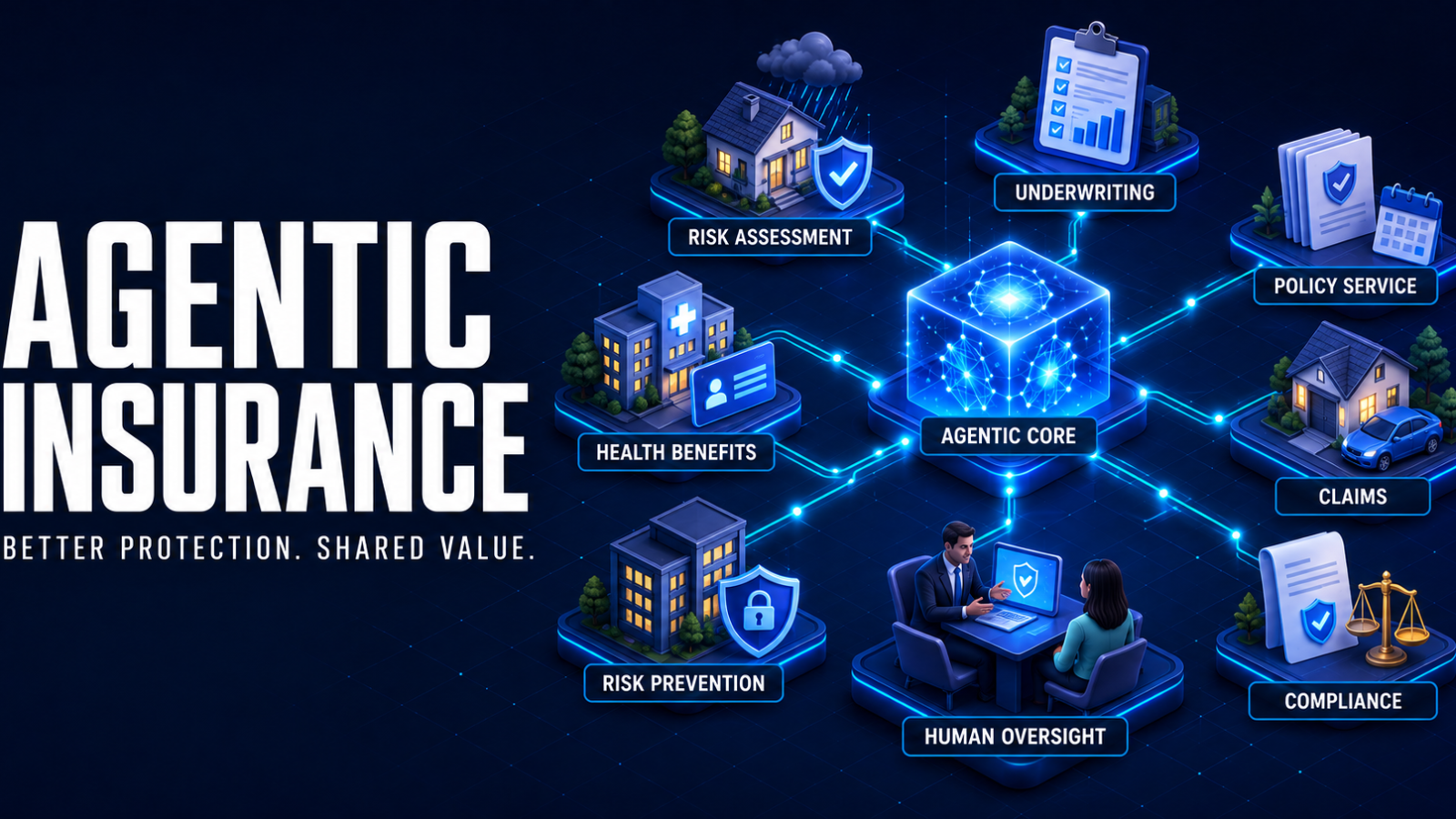
Agentic Insurance: Continuous Protection, Better Value and Sustainable Growth
How AI agents can improve coverage, pricing, service and claims for customers—and help insurers build stronger businesses
Insurance protects people and businesses from bearing the full financial cost of covered risks and adverse events. It must also generate enough revenue for insurers to pay claims, maintain capital and earn a sustainable profit. Agentic AI can help balance those interests by reducing unnecessary work, improving risk assessment and making protection easier to buy, maintain and use.
Executive summary
Insurance supports medical care, homeownership, mobility, business activity and retirement. Customers need affordable protection that works after a loss; insurers need premiums that cover claims, operations and capital. Both benefit when coverage fits the risk and service works well.
Expensive premiums, inflexible choices and difficult claims strain household and business finances. Insurers face rising losses, fragmented data, legacy systems and demanding regulation. Repeated work raises costs on both sides, while gaps in health, auto, property, life and business coverage leave important needs unmet.
Agentic AI can make insurance a continuously managed service: keeping protection aligned with changing needs, reducing administrative friction, and helping prevent and resolve losses. Flexible, modular products are one part of that shift. Agents can also improve ordinary annual and long-term policies by coordinating evidence, approved decisions and follow-through across the insurance lifecycle.
Startups need not limit themselves to supplying incumbents. They can win customers through better service, develop focused products or replace costly operational systems. Established insurers can build directly, partner, invest or acquire, combining capital and risk expertise with new capabilities. Competition should push both to deliver better protection and serve markets previously too expensive to reach.
The goal is continuous protection, better value and sustainable growth, with humans retaining consequential judgment. Success means fewer coverage gaps, stronger businesses and better-quality jobs, alongside economic resilience that benefits communities and governments—not simply charging more or paying less.
Part I — The economics of useful protection
1. Protection that works for customers and insurers
Insurance transfers specified financial risks to an insurer in exchange for a premium. Underwriters assess the exposure and set terms; claims teams establish what is covered and owed; actuaries estimate future obligations; and reinsurance and investment management support the capital behind those obligations. Customers gain protection against losses they may struggle to absorb. Insurers earn revenue by pooling, pricing and managing those risks.
The relationship includes more than two parties. Brokers help customers find suitable cover, medical and repair networks deliver services, reinsurers support capacity, and governments set rules or share certain risks. Agents can reduce the repeated work between them without changing who is responsible for the contract or decision.
Coverage gaps extend beyond home insurance
| Insurance category | U.S. coverage gap | Population and evidence |
|---|---|---|
| Health | 8.0% uninsured throughout 2024 | People with no health coverage at any point in the year. |
| Personal auto | 15.4% of drivers uninsured in 2023 | IRC estimate of uninsured motorists, not uninsured households. |
| Homeowners | 6% of homeowners uninsured in 2025 | Homeowners only; not a measure of all property or disaster protection gaps. |
| Life | 38%, roughly 92 million adults, say they need coverage or more coverage in 2026 | Self-reported need, not the same as having no policy. |
| Small-business insurance | 13% had no insurance; 77% were underinsured in a 2025 survey | Hiscox survey of 2,000 U.S. business owners with 1–50 employees; not a census of all firms. |
| Cyber | 35% lacked cyber coverage the study assessed they needed | The same Hiscox small-business survey; not an additional population to count. |
These measures cannot be added into a single uninsured percentage: populations overlap, years differ, and being uninsured is different from being underinsured. Together, they show demand that clearer advice, simpler enrollment and more economical service could help meet.
Capital, contracts and public responsibility
Customers need reliable payment and fair treatment. Insurers need viable rates and enough capital to absorb volatility. Policymakers need broad access without weakening solvency, while governments must manage public exposure to disasters and other difficult risks. Those interests can conflict: suppressing premiums below sustainable levels can restrict supply, while unrestricted pricing and opaque exclusions can leave essential protection out of reach.
States supervise insurers, licenses and market conduct. Risk-based capital and insurer-funded guaranty systems serve different purposes from federal flood, crop and terrorism programs. Public support is not a blanket taxpayer guarantee for the industry. Agentic systems can make decisions and program coordination easier to inspect, but elected officials and regulators still decide how risk and cost should be shared.
2. Insurance categories and the outcomes they deliver
Insurance products address different risks and stages of life or business. The useful question is what an agent can improve for that particular customer and insurer.
| Insurance category | Products | Outcome | Agentic benefits |
|---|---|---|---|
| Life and retirement | Term and permanent life; annuities | Family income protection and retirement income | Maintain suitable cover and beneficiaries; coordinate benefit and claim records |
| Health and income protection | Medical, disability and long-term care | Access to care and financial support during illness | Coordinate enrollment, authorization and appeals; follow claims to resolution |
| Personal auto | Liability, collision and comprehensive | Affordable mobility and protection after an accident | Compare fixed and mileage-linked cover; maintain protection and repair progress |
| Home and personal property | Homeowners, renters and umbrella | Restore belongings or housing; protect against liability | Match cover to assets; verify prevention work and coordinate approved repairs |
| Commercial and workforce | Property, liability, interruption and workers’ compensation | Keep the business and employees operating | Update exposures; reconcile premiums and coordinate loss-recovery evidence |
| Cyber and professional liability | Cyber, E&O and D&O | Manage digital incidents and professional liability | Verify controls; connect incident evidence with specialist response and claims |
| Specialty and catastrophe | Flood, agriculture, marine and other specialist cover | Protect risks outside standard policies | Gather specialist evidence; match risks to suitable capacity |
| Reinsurance | Treaty and facultative | Stabilize insurers and expand capacity | Reconcile exposures and contract terms; track recoverables |
The shared process is exposure assessment, coverage, servicing, loss response and renewal. Agents connect the supporting information across that process; product-specific rules determine what can be priced, changed or paid.
3. Customer touch points across the insurance lifecycle
Customers need help choosing cover, maintaining it and using it after a loss. Agents can resolve missing evidence and follow work across these touch points. Startups can win business by removing repeated requests, unclear decisions and slow follow-up; insurers can improve the same processes themselves or buy that capability. Better service and lower rework benefit both sides.
| Customer touch point | Customer pain points | Agentic AI impact |
|---|---|---|
| Comparing cover | Similar prices hide different limits, exclusions and durations; fixed plans may fit irregular use poorly | Compare fixed and flexible options on equivalent protection, total premiums and likely out-of-pocket costs |
| Applying | Repeated requests for medical, driver, payroll, property and business information | Reuse consented records; prefill forms and resolve missing or conflicting answers |
| Receiving a decision | Unclear rating inputs, stale records and slow referrals | Check source data; run approved eligibility or rating tools and prepare exceptions for an underwriter |
| Changing or renewing | New activities or assets outgrow cover; expiring components can leave unnoticed gaps | Identify relevant changes; quote suitable updates and verify effective dates before replacing protection |
| Using benefits or making a claim | Uncertain eligibility, repeated evidence requests and poor visibility of progress | Check applicable cover; request only missing records, route qualified reviews and track decisions through completion |
| Resolving a dispute or completing recovery | Disconnected appeals, payments, care and repair services | Assemble appeal evidence; follow deadlines and confirm that approved payments, care or repairs actually occur |
A useful agent remembers what has already been supplied and follows up on what is still missing. It should not make the customer repeat the same story to sales, service and claims—or make an employee reconstruct the file at every handoff.
Part II — Making protection continuous
4. How a continuous protection system works
A continuous protection system keeps track of changing needs, active cover and unfinished work. It can support an annual policy, long-term cover or approved modular components. Agents connect service, prevention and claims to the same dated coverage record, so the customer does not have to manage every handoff. An add-on can remain within one policy; continuity does not require multiple contracts.
The insurance lifecycle through a ReAct loop
ReAct alternates reasoning, action and observation: examine the case, use a tool, check the result and revise the plan. Unlike a fixed script, an agent can select the next permitted step when evidence is missing or contradictory. It resembles a professional working through incomplete information, without implying identical thinking.
Insurance event → Gather insurance context → Interpret the contract → Reason and plan the response → Coordinate evidence and tools → Verify details → HITL approval where required → Execute the approved action → Feedback loop
An event may be a purchase, changed usage or a loss. The agent gathers context, resolves gaps and checks the result of each tool call before continuing. Feedback updates the case and informs tested improvements; it does not silently change policy rules. Predictable calculations remain in validated rating and transaction systems.
| Agentic architecture layer | What the agent does | Insurance example |
|---|---|---|
| Orchestrator and specialist agents | Assign case tasks, follow dependencies and track unresolved work | A health coordinator follows missing eligibility evidence through to an enrollment decision |
| Context | Retrieve current needs, contract terms and eligible product combinations | A home agent checks whether a rental period needs an add-on to existing cover |
| Memory | Retain relevant history, customer choices and dated coverage records | A claims agent reconstructs which policy and endorsements applied when damage occurred |
| Reasoning and planning | Choose the next permitted step; revise the plan when evidence conflicts | An auto agent resolves conflicting mileage records before requesting comparable quotes |
| Tools and execution | Call approved rating, policy and payment services; confirm results | A commercial agent submits an authorized equipment add-on and verifies issuance and billing |
| Guardrails and security | Restrict data use and block unauthorized pricing or coverage changes | A service blocks cancellation of existing cover until required replacement and consent checks pass |
| Observability and human oversight | Show evidence, alternatives and responsibility for each decision | An underwriter reviews proposed terms; the customer receives clear costs and effective dates |
If rented equipment is damaged during a project, an agent checks the applicable policy and rental agreement, requests a missing inspection record and routes a coverage question to an adjuster. After approval, it verifies payment or repair progress. Success is a resolved case, not simply a completed summary.
HITL means human-in-the-loop review before a consequential decision, with evidence, uncertainty and proposed action visible to a qualified person. Routine permitted tasks can proceed within established limits; disputed cover, clinical decisions and consequential exceptions require professional review.
A health-insurance example
Consider a $20,000 knee-replacement procedure requiring hospital admission. An agent can verify benefits, assemble clinical records, identify missing information and track the authorization request. It reduces the administrative work for the patient, hospital and insurer without deciding that an expensive procedure should be rejected.
A prompt telling the agent not to deny solely because of cost is only an instruction. A claims or authorization service that technically blocks an automated denial and requires authenticated clinical review is a guardrail. The reviewer applies the relevant coverage and medical-necessity criteria, records the decision and preserves the patient’s appeal route. The dollar amount here is illustrative, not a quoted treatment price.
5. The core insurance processes agents can improve
Existing policies and new products both need connected operations. Agents help move work from evidence to an authorized, verified outcome across these processes.
| Internal process | Data sources | Agentic AI activity | Measurable benefit |
|---|---|---|---|
| Product design, underwriting and pricing | Policy forms, claims history, exposure data, rating tools and filings | Resolve evidence gaps; test terms through validated models and prepare expert referrals | Faster underwriting and product development; viable pricing for smaller exposures |
| Application and policy issuance | Applications, eligibility, producer records, quotes and endorsements | Reuse information; resolve inconsistencies and verify authorized issuance and effective dates | Lower abandonment; fewer unintended gaps at activation |
| Servicing, billing and renewal | Policy versions, billing, payroll, mileage and asset records | Investigate discrepancies; request permitted corrections and verify the updated bill and cover | Fewer billing errors and repeat contacts; lower servicing cost |
| Prevention and risk management | Inspections, property imagery, safety and cyber-control records | Identify relevant hazards; arrange approved work and verify completion | More completed mitigation; lower preventable loss |
| Claims and health authorization | Dated policy terms, clinical records, loss evidence and payment systems | Obtain missing evidence; route qualified decisions and follow approved care, repair or payment | Faster correct resolution; fewer disputes and repeated requests |
| Legal, compliance and assurance | Rules, complaints, notices, filings, contracts and audit records | Check permitted combinations and disclosures; assemble reviews and track deadlines | Fewer invalid changes; less examination preparation |
| Reserving, reinsurance and portfolio management | Claim development, exposure records, treaties and recoverables | Reconcile data; flag unusual changes and prepare actuarial analysis | Fewer data breaks; faster recoveries and better accumulation visibility |
Part III — Choosing cover in everyday life
6. Buying insurance when the stakes are personal
The same technology should help a family understand medical costs, a new driver get appropriate cover and a business owner protect the company without losing days to administration.
Journey one: a family choosing health insurance
A family changing jobs must compare premiums, deductibles, medicines and provider networks while avoiding a gap before new employer coverage starts. The cheapest premium may not mean the lowest total cost. Flexibility here means finding suitable coverage for the transition, not switching medical insurance on only when someone becomes ill.
An agent can help the family:
- assemble household information, employer coverage dates and enrollment eligibility with permission;
- check doctors and regular medicines against current plan records;
- compare eligible plans, subsidies and likely care costs over the transition;
- prepare enrollment, identify missing evidence and route advice to a qualified person; and
- confirm start and end dates, preserving continuity and checking benefit or deductible changes.
The family gets a clearer choice; the insurer receives a more accurate application. After enrollment, the same service can gather evidence for a treatment authorization and track qualified review. Health information supports care needs, not unlawful repricing.
Journey two: buying car insurance for the first time
A first-time buyer who drives occasionally may still receive expensive fixed-premium quotes. Before leaving the dealership, they must understand state minimums, lender requirements and optional protection. A mileage-based option could fit better, but a cheaper quote may simply remove cover or increase the deductible.
An agent can:
- collect driver, vehicle, usage and financing details once;
- explain required and optional cover in plain language;
- compare fixed and mileage-based carrier quotes using the same limits and deductibles;
- estimate bills at low and high mileage, including base charges and eligible discounts; and
- obtain required approval, confirm proof of cover and review suitability when driving changes.
The buyer sees when fixed or mileage-based cover fits better; the insurer gains reliable usage information. After an accident, the agent can assemble the claim and follow approved repairs, using the policy in force at the time.
Journey three: commercial and cyber insurance for a small business
A small firm needs ongoing liability, workforce and cyber protection, but equipment and project exposures may change month by month. Annual commitments, estimated payroll and repeated paperwork can strain cash flow. Clients still demand certificates and limits, while cyber incidents or liability claims may surface after a project ends.
An agent can:
- assemble existing policies, contracts, payroll, assets and loss records;
- distinguish ongoing obligations from temporary exposures and identify gaps or duplicate cover;
- gather cyber-control evidence and compare annual packages with approved project-specific options;
- prepare broker submissions and reconcile eligible payroll-linked payments; and
- confirm approved changes, issue authorized certificates and track expiries and continuing obligations.
The owner matches cover to actual work; insurers gain better exposure evidence. After a cyber incident, the agent can coordinate notices and records for response specialists and claims reviewers. Payroll-linked payments help cash flow but do not eliminate audits or guarantee lower annual premiums.
Part IV — Building the next generation of insurance services
7. Where startups and incumbents can build together or compete
Customers do not owe established providers their loyalty. Startups can win relationships through clearer coverage, reliable claims support and service for overlooked customers. They can also compete for insurers’ operating budgets by replacing costly software or manual work. The advantage must come from better outcomes and economics—not merely putting an agent interface on the same process.
| Layer to own | Primary stakeholder | Startup opportunity | Incumbent role and competitive implications |
|---|---|---|---|
| Product development | Product teams, actuaries and MGAs | Test conventional and modular terms; prepare reviewed pricing and filing evidence | Carriers can adopt tools or face faster niche launches; Guidewire and Duck Creek provide core platforms |
| Licensed coverage services | Small firms and insurance buyers | Maintain client cover; follow renewals and claims. Service example: WithCoverage | Brokers compete for the customer relationship; carriers supply protection |
| Underwriting support | Underwriters and portfolio teams | Resolve submission gaps and prepare decisions. Technology examples: Sixfold, Federato | Carriers and MGAs can expand capacity; existing software must demonstrate comparable value |
| Policy and claims operations | Service teams and claims professionals | Resolve record discrepancies and follow claim tasks. Technology examples: Bevaya, Sprout.ai | Insurers can buy or build; software providers and outsourcers compete on resolution cost and quality |
| Property assessment and prevention | Risk engineers, adjusters and policyholders | Connect property evidence to inspections and repairs. Technology examples: ZestyAI, Tractable | Insurers and repair networks gain capability; assessment providers face new alternatives |
| Reinsurance operations | Carriers, reinsurers and brokers | Reconcile exposures and contract records. Technology example: Supercede | Reinsurers and brokers gain capacity; manual reconciliation services face pressure |
| Compliance operations | Legal, compliance and operating teams | Check records and prepare review packets. Technology example: FurtherAI | Insurers buy capabilities; enterprise platforms such as ServiceNow can integrate or compete |
Four routes into the market
These are alternative business models, not stages every startup must pass through.
- Workflow supplier: earn software revenue by resolving billing or claims work more effectively than existing tools. The insurer retains product and decision authority.
- Licensed service business: compete for customers through agent-assisted advice, policy management and claims support. Lower servicing costs can make small accounts attractive.
- Delegated program: develop a focused offer, such as project-equipment cover, using agents to gather evidence and administer terms within carrier authority.
- Independent insurer: obtain the licenses, capital and reinsurance to carry risk and compete directly on products, pricing and service.
The regulatory moat is real: agents can reduce compliance work, not replace licenses or capital. Risk-bearing insurers face financial and operational review. Texas P&C insurers, for example, need at least $5 million in capital and surplus, separate from setup expenses. The Uniform Certificate of Authority Application process targets 90 days from a complete application; preparation and follow-up can extend the timeline. These are not an industry-wide startup cost or launch guarantee.
Incumbents can redesign their own services, buy missing capabilities, invest or acquire. Partnerships can combine regulated capacity with technical speed, while competitors pursue customers left dissatisfied. A startup may compete with a broker while using an established carrier’s products. Contracts should make customer ownership, data rights and claims responsibility clear; partnership is a choice, not every startup’s destination.
8. Continuous insurance through flexible, modular products
Modularity changes what is covered, for how long or how premiums are calculated: a project policy, an asset add-on, mileage-linked pricing or a life-stage adjustment. Agents can help design and maintain these options alongside conventional policies. The service remains continuous even when the appropriate product is an unchanged annual or long-term contract.
Pay-per-mile auto and job-specific business cover already exist. The agentic opportunity is to make suitable products easier to deliver and use. Payroll-linked workers’ compensation aligns payments with exposure; health navigation maintains suitable coverage. Neither makes insurance something customers switch on only after a need or loss arises.
| Product and agent-enabled service | Primary buyer | Persistent problem | Agentic AI Benefits |
|---|---|---|---|
| Life-stage health coverage: regulated monthly premiums and eligible subsidies | Families and employers | High premiums, limited plan choices and job changes make suitable coverage difficult to maintain | Compare total costs, networks and subsidy eligibility; coordinate coverage for employment transitions without gaps |
| Mileage-based auto: base charge plus a per-mile premium | Drivers and fleets | Broad mileage estimates can overcharge light users; annual installments offer little usage flexibility | Verify consented mileage; compare approved usage-based quotes and maintain required cover as driving changes |
| Modular home protection: core policy plus separately priced add-ons | Homeowners, renters and landlords | Bundles may poorly match valuable belongings, renovations or temporary rental use | Match assets and occupancy periods to approved add-ons; compare costs while retaining essential dwelling and liability protection |
| Trip-based travel cover: price by dates, destination and insured trip value | Travelers and traveling workers | Repeated purchases are confusing; annual cover may be unnecessary for occasional travel | Read itineraries, check existing benefits and quote trip-specific protection; arrange permitted extensions when plans change |
| Flexible commercial cover: project policies or payroll-linked premium payments | Small firms and seasonal employers | Annual commitments and estimated payroll strain cash flow when work is intermittent | Use contracts and payroll to quote project cover or reconcile payments to actual exposure; reduce rework and audit surprises |
| Adaptive cyber cover: ongoing policy with approved adjustments to limits and pricing | Small and midsize businesses | Static questionnaires can miss improved security or changing exposure, weakening the match between premium and risk | Verify security controls and business changes; prepare evidence for better terms while preserving continuity for later-reported claims |
| Life-stage family protection: layered term-life amounts and durations | Households and working parents | One fixed coverage amount may poorly fit debts and dependents whose needs decline over time | Compare layered-policy costs and coverage periods; check future insurability before recommending changes |
| Climate and catastrophe cover: core protection with seasonal options where offered | Households and businesses | High premiums and rigid limits can leave exposed customers unable to afford adequate protection | Combine hazard and mitigation evidence; quote suitable limits before risk periods and check waiting periods |
Insurers define compatible cover and validated rating rules. Agents gather permitted exposure data, test options through pricing tools and prepare expert reviews. Where suitable, a base charge funds ongoing risk, with approved usage charges and optional cover added. Prices must support expenses and capital; shorter periods are not automatically cheaper per day. Clear estimates and consent matter as much as flexibility.
Health and home require particular care. Enrollment rules govern health transitions; short-term medical policies are not equivalent to comprehensive cover and may exclude pre-existing conditions. ACA-compliant individual-market premiums cannot be personalized to medical history. Home add-ons should not leave essential dwelling protection or lender requirements unmet.
The aim is continuous protection through modular products, not constant repricing or fragmented responsibility. Startups and insurers can compete on the resulting service: suitable cover, understandable bills, verified changes and reliable help after a loss. Lower servicing costs and better risk evidence can support affordable entry points and sustainable revenue.
Part V — Better work for humans and stronger insurance economics
9. From administrative burden to human potential, better jobs and growth
Augment jobs and make room for more valuable work
Agentic insurance should be built for job augmentation, not job replacement. Handling repeated forms, evidence requests and status updates frees people to advise customers, resolve difficult cases and develop neglected services. The goal is better-quality work and more room for creativity, not simply higher workloads.
New products, prevention and service for smaller customers can generate revenue that supports hiring. Employment growth depends on viable demand and reinvestment, not automation alone. The ILO’s research points toward transformation rather than redundancy for most exposed jobs; how employers redesign work matters.
| Role | Busy work agents can absorb | Better work and growth opportunities for people |
|---|---|---|
| Licensed broker or benefits adviser | Prefill applications; compare approved options and prepare certificates | Explain fixed-versus-flexible trade-offs; help smaller customers maintain suitable cover |
| Underwriter | Extract submissions, check guidelines and request missing payroll or cyber evidence | Design viable terms for changing exposures; assess unusual risks and underserved markets |
| Claims professional or clinical reviewer | Assemble policy, damage or medical records; track requests and deadlines | Resolve complex claims, review clinical evidence and support people through difficult decisions |
| Policy-service specialist | Reconcile billing, enrollment, vehicle changes and renewal records | Guide life-event changes; improve continuity across health, auto, home and life cover |
| Risk engineer or cyber specialist | Compile inspections, control records and mitigation follow-ups | Design practical prevention plans; deliver ongoing services to more homes and businesses |
| Actuary or product specialist | Prepare data, run approved scenarios and document comparisons | Design compatible modules; test selection, sustainable pricing and customer value |
| Compliance and assurance professional | Retrieve requirements, check notices and assemble audit evidence | Resolve difficult regulatory questions; supervise agent workflows and improve customer recourse |
| Early-career insurance professional | Organize files, prepare case summaries and complete routine checks | Learn through supervised cases, customer conversations and rotations into underwriting, claims or product work |
Turn saved time into career and business growth
- Redesign work with employees. Allocate saved time to complex cases, customer relationships and neglected projects. Measure useful work and job quality.
- Build stronger entry-level careers. Continue junior hiring, mentoring and supervised cases. Faster access to context should accelerate professional learning.
- Share governance. Frontline teams, licensed specialists and compliance should shape workflows, with authority to question, correct and stop an agent.
- Reinvest in new services and roles. Extend advice, prevention and product development to underserved accounts; hire as sustainable demand grows.
Value must show up in insurance economics
The investment test is useful protection and measurable value after full program cost, not the number of documents processed.
My earlier global economic-value article models an annual insurance opportunity of $150B enabled by 2031, with $100B captured before costs and $80B of net economic benefit. The arithmetic remains $40B from operations and employee capacity + $30B from prevention and new products + $30B from loss, reserve and portfolio improvement − $20B in full program costs = $80B. This is a global author-modeled scenario, not an observed result or a percentage of the $980B U.S. P&C premium figure.
For one insurer, use a workflow-level test:
Net economic benefit from Agentic AI = redeployed capacity value + incremental contribution margin + verified reduction in insured losses − full program cost
Count redeployed time only when it produces useful work; do not count the same gain again in margin or loss savings. Customer savings are not extra insurer revenue. Lower claim payments create value through genuine prevention or reduced leakage, not underpayment of valid claims. Full cost includes technology, integration, controls, employee transition, oversight and failure response.
Track cost per resolved case, customer effort, coverage gaps, newly served accounts and insurer margin. Compare premiums alongside deductibles and uninsured exposure: smaller installments or reduced protection are not automatically savings. Lower operating costs do not automatically become lower premiums either; leadership should decide how verified gains support customer value, employee development, reinvestment and sustainable returns.
The job augmentation dividend
The dividend starts when employees use freed capacity to deliver better advice, resolve claims and reach smaller customers. Customers gain less effort and more dependable protection; insurers gain retention, useful risk evidence and room for profitable growth. Measure skills, career progression and net employment created, not just hours automated.
The wider benefit comes from fewer preventable losses, faster recovery and businesses able to keep investing and employing people. Governments can gain more efficient oversight and less pressure from uninsured losses. But shifting a bill from public budgets to households is not itself a net economic gain. Real resource savings and additional productive activity—not transfers between parties—make the stronger national case.
Part VII — Agentic AI earning the right to act
13. Eight decisions for scaling Agentic AI in insurance
Treat Agentic AI as an insurance-business investment, not a technology demonstration. Establish today’s product economics, service performance and employee workload, then decide what must improve before committing to wider deployment.
| Leadership decision | Insurance-specific question | Value provided by Agentic AI |
|---|---|---|
| Choose the product opportunity | Which unmet need should we address first—health-plan transitions, mileage-based auto or project-based commercial cover—and can we offer flexibility without coverage gaps? | More suitable products, broader access and new premium or service revenue |
| Prove and share the net financial return | Do margin, capacity and loss improvements exceed full costs, including capital needs—and how will verified gains reach customers, employees and reinvestment? | Sustainable returns, better customer value and a clear allocation of productivity gains |
| Improve pricing and decision quality | Can agents use approved rating tools and correct policy evidence to reduce misquotes, unsupported exclusions and claim errors—and demonstrate fair treatment across customer groups? | More dependable underwriting, fewer corrections and disputes, and defensible risk-based pricing |
| Reduce customer effort | Which quote, policy-change or claims journey will require fewer repeated forms and calls, resolve correctly sooner and generate fewer complaints? | Lower service costs, faster assistance and stronger customer retention |
| Make compliance repeatable | Can agents reuse reviewed product-and-state checks to prepare complete filings, meet notice deadlines and produce regulator-ready evidence without bypassing required approvals? | Less duplicated compliance work, fewer filing deficiencies and more reliable market expansion |
| Turn capacity into better work and growth | Where will freed adviser, underwriting and claims hours go—complex cases, underserved small accounts, product design or junior training—and which growing services can support hiring? | Higher-quality jobs, greater service capacity and revenue that can fund new roles |
| Decide when to expand authority | What accuracy, fairness, security and coverage-continuity results must a product pilot achieve before live transactions or another state—and what triggers human intervention or a pause? | Fewer unauthorized actions and coverage errors, with evidence-based expansion |
| Choose where to build, partner or compete | Which customers and revenues could move to a better competitor, why would they switch, and should we build, partner, invest or acquire to serve them better? | Stronger retention, new markets and investment tied to a specific competitive response |
The investment case is better insurance: useful products, fewer service failures, easier compliance and net value after full cost. Unmet needs create openings for startups and faster incumbents. Leaders should choose what to build or buy, how to share the gains and which customer outcomes justify expansion—not adopt agents simply because competitors have them.
Conclusion: building a more useful insurance system
Insurance should make financial shocks manageable for customers and remain a sustainable business for those providing protection. Expensive cover, difficult processes and uninsured losses put pressure on households, companies and public resources. Insurers face rising claims costs and operational complexity of their own. A better system must improve both sides of that equation.
Continuous protection is the goal; flexible, modular products are one way to deliver it. Agentic AI can connect risk assessment, approved pricing, coverage changes and claims so protection follows changing lives and businesses. That means dependable core cover with suitable options—not constant repricing or disconnected policies. Lower administrative costs and better prevention can support more affordable choices, stronger margins and new services.
Startups can win customers, develop focused products and replace costly processes; they need not become suppliers to established firms. Incumbents can improve their own offerings, partner where capabilities are missing, invest or acquire. Both must meet their obligations. Partnership can accelerate delivery, while competition challenges poor service and unmet needs. Neither substitutes for providing better insurance.
Employees gain when repetitive work gives way to better advice, complex decisions and product development. Reinvesting that capacity can generate revenue and support new jobs. For the wider economy, broader coverage and faster recovery can help families remain financially secure and businesses keep investing and employing people. Governments can benefit from clearer oversight and less pressure from uninsured losses, while retaining responsibility for public protections.
These gains must be earned through fair pricing, dependable claims payment, measurable net value and accountable human oversight. Agentic AI cannot remove the underlying cost of risk, but it can help reduce the avoidable cost and difficulty of managing it.
The challenge is what we choose to build next. Will we keep asking households, businesses and governments to absorb the burden of fragmented insurance—or use Agentic AI to make protection more flexible, service more dependable and growth more widely shared?
Selected research and source guide
Industry economics, products and markets
- NAIC, 2025 Property & Casualty and Title Insurance Industries Analysis
- NAIC, 2025 Life Industry Commentary
- NAIC, 2025 Health Industry Commentary
- NAIC, Insurance Industry Snapshots and Analysis Reports
- OECD, Gross Insurance Premiums
- NAIC, Telematics and Usage-Based Auto Insurance
- NAIC, Travel Insurance
- The Hartford, Pay-as-You-Go Workers’ Compensation
- Thimble, Business Coverage by the Job, Month or Year
- Guardian, Multiple Life Policies and Laddering Coverage
- Washington Office of the Insurance Commissioner, How Home Insurance Works
- HealthCare.gov, Getting Coverage Outside Open Enrollment
- HealthCare.gov, How Health Premiums Are Set
- Washington Office of the Insurance Commissioner, ACA and Non-ACA Health Coverage
- NAIC, Cyber Insurance Report: Coverage and Claims-Made Terms
Coverage gaps, affordability and public programs
- U.S. Census Bureau, Health Insurance Coverage in the United States: 2024
- Insurance Research Council, Uninsured and Underinsured Motorists
- LIMRA and LOMA, 2026 Life-Insurance Coverage Gap
- Hiscox, 2025 Underinsurance in Small Business Report
- Federal Reserve, Economic Well-Being of U.S. Households in 2025: Housing
- GAO, Homeowners Insurance: Premiums Generally Tracked Inflation but Rose More in Disaster-Prone Areas
- U.S. Treasury, Federal Insurance Office Homeowners Insurance Analysis
- FEMA, National Flood Insurance Program Financial Report
- USDA Risk Management Agency, Program Budget and Financial Highlights
- U.S. Treasury, Terrorism Risk Insurance Program
Regulation, AI and consumer protection
- NAIC, McCarran–Ferguson Act
- NAIC, SERFF: Shared Rate and Form Filing Infrastructure with State-Specific Requirements
- NAIC, Risk-Based Capital
- NAIC, Uniform Certificate of Authority Application: Requirements and 90-Day Review Target
- Texas Department of Insurance, How to Incorporate a Texas Insurance Company: Minimum Capital and Surplus
- NAIC, Guaranty Associations and Funds
- NAIC, AI Model Bulletin Implementation Map
- NAIC, Artificial Intelligence: Insurance Uses, Risks and Governance
- New York DFS, Circular Letter 7 on AI and External Consumer Data
- U.S. HHS, Summary of the HIPAA Privacy Rule
- CMS, Interoperability and Prior Authorization Final Rule
- U.S. Department of Labor, Health Plans and ERISA
- NIST, Generative AI Profile
Agentic systems, economic value and work
- Yao and colleagues, ReAct: Synergizing Reasoning and Acting in Language Models
- Indus Agent AI, Agentic AI: $16Tn in Global Economic Value Enabled and $8Tn Captured
- BLS, Insurance Carriers and Related Activities
- BLS, Occupational Projections and Characteristics
- ILO, Generative AI and Jobs: A 2025 Update