
This post is to share my thoughts on Agentic AI transforming and disrupting most industries. There are lots of ideas that can be converted to startups, no shortage. Main skill will be execution and distribution, as always, but even more so now with all the AI tools. Small team of technical and industry domain expert and maybe a sales marketing person. But it’s going to be very founder driven, minimal tech and advisory support. Rely on direct customer engagement using the current tools of social media, podcasts, substack, direct reach, etc.
I am more excited than ever, can’t sleep, can’t sit still, too much to do. Taking the positive growth better future mindset will show ideas, possibilities that negative thinking will never grasp. Hope this helps. Will be refining this thought chain with more articles, podcasts, etc.
“The question is no longer whether AI will transform your industry. The question
is whether your startup will lead that transformation — or become a casualty of it.”
PART 1 | THE CURRENT STATE: FROM COPILOTS TO AUTOPILOTS
We have crossed a threshold. And some of the world’s most sophisticated investors
have said so in writing.
Agentic AI refers to autonomous AI systems that perceive goals, plan multi-step
strategies, use tools, remember context across sessions, and execute tasks with
little or no human intervention. This is fundamentally different from a chatbot
that answers questions. An agent does things — searches the web, writes and runs
code, calls APIs, fills forms, drafts contracts, books appointments, monitors
pipelines, and hands off tasks to other specialized agents.
The numbers confirm the momentum:
– Agentic AI startups raised $2.8 billion in H1 2025 alone, with full-year
projections hitting $6.7 billion (Prosus / Dealroom report).
– The broader agentic AI market, valued at ~$30.9 billion in 2024, is growing
at a CAGR of 31–47% depending on the segment tracked.
– By 2026, the total sector has attracted over $24.2 billion in cumulative
venture funding, with 2026 YTD already showing a 142.6% year-over-year
increase (Tracxn, April 2026).
– Deloitte projects that 25% of companies using generative AI will launch
agentic pilots in 2025, growing to 50% by 2027.
– Gartner forecasts that 33% of enterprise software applications will embed
agentic capabilities by 2028 (up from near-zero in 2024).
The pivot from “AI that suggests” to “AI that executes” is not incremental. It is
architectural. And it opens the door for an entirely new generation of startups
to build vertical applications that were previously impossible.
The enabling technology stack making this possible:
– FOUNDATION MODELS: GPT-4o, Claude 3.x/4.x, Gemini — the reasoning core
that crossed the intelligence threshold enabling autonomous action.
– MODEL CONTEXT PROTOCOL (MCP): Anthropic’s open standard — described by
Bessemer as “USB-C for AI” — that lets agents connect standardized tools,
APIs, and data sources with persistent context.
– AGENT-TO-AGENT PROTOCOLS (A2A): Standards enabling multi-agent
coordination, delegation, and specialization at enterprise scale.
– ORCHESTRATION FRAMEWORKS: LangGraph, CrewAI, AutoGen, Akka — managing
state, memory, decision loops, and multi-agent workflow coordination.
– VECTOR DATABASES: Pinecone, Weaviate, pgvector — long-term memory that
makes agents domain-accurate across sessions.
– LLM OBSERVABILITY: LangSmith, etc — the tracing and
evaluation layer that makes production agents trustworthy and improvable.
– MULTIMODAL CAPABILITIES: Voice, vision, image — unified into a single
agent interface that can perceive and act across every human channel.
The window for founders to build category-defining vertical positions in
agentic AI is open right now. Every major VC firm is saying the same thing
with their checkbooks.
PART 2 | THE GREAT DEBATE: CREATIVE DESTRUCTION OR ECONOMIC RENAISSANCE?
Let’s be honest about both sides of this argument. The stakes are too high for
comfortable platitudes — and the VCs themselves are not avoiding it.
THE CASE FOR CONCERN
──────────────────────
The disruption is real, measurable, and already underway:
– The ILO (2025) estimates that over 600 million jobs globally — roughly a
quarter of all employment — are exposed to generative AI effects.
– Goldman Sachs estimates 6–7% of the U.S. workforce faces net displacement
risk, with ~300 million full-time job equivalents globally affected.
– UPS eliminated 20,000 jobs and closed 73 facilities in 2025 after deploying
AI logistics optimization systems. Salesforce cut 4,000 customer service
roles after AI agents began handling ~50% of interactions.
– McKinsey estimates today’s deployed technology could theoretically automate
~57% of current U.S. work hours. Deployment is the limiting factor.
– One forecast from a senior AI operator: “90% of all white-collar corporate
roles I have seen can be automated with current AI models and the right
agent harness.” That is not a fringe view — it is an engineering assessment.
– Entry-level white-collar workers are disproportionately affected. Younger
tech workers (20–30 years old) have seen unemployment rise nearly 3
percentage points since early 2025.
These are not fear-mongering statistics. They describe a real transition that
demands policy attention, reskilling investment, and social safety net reform.
The political consequences — income polarization, geographic displacement,
skills gaps — are legitimate and must be taken seriously by anyone building
in this space.
THE CASE FOR OPTIMISM (AND THE VC CONSENSUS)
──────────────────────────────────────────────
The historical record, economic theory, and the most credible data all point
toward net positive outcomes — and here, the VC community has been unusually
forthcoming and data-driven:
– The WEF Future of Jobs Report 2025 projects 170 million new jobs created
by 2030, offsetting 92 million displaced — a net gain of 78 million.
– ITIF (December 2025): AI created roughly 119,900 jobs in 2024 while only
~12,700 were lost. The ratio is nearly 10:1 in favor of creation.
– Gartner projects that by 2028, AI will create more jobs than it destroys
across the global economy.
– New role categories are emerging at pace: AI trainers, agent orchestration
engineers, prompt engineers, AI ethics officers, data curators, AI product
managers, agent QA specialists, and AI-augmented domain experts across every
professional field.
– Wage premiums have already emerged for workers with demonstrable AI
skills — a powerful market signal about where value is migrating.
– a16z published its “Big Ideas 2026” series, articulating a parallel shift: AI is moving from prompting to execution. Described a world where “interfaces shift from chat to action, design shifts from human-first to agent-readable, and work shifts to agentic execution. AI stops being something you ask, and becomes something that
does.”
– Sequoia notes the best AI startups are achieving “north of $1M in revenue
per employee” — an efficiency ratio that implies massive value creation
per company, generating new economic surface area.
– Bessemer Venture Partners called the same transition from the infrastructure
side in their State of AI 2025 Report: AI is building “Systems of Action” on
top of existing “Systems of Record.” The legacy enterprise software platforms
that store and organize data are being overlaid by AI-native platforms that act
on that data — faster, cheaper, and with compounding capability.
The Jevons Paradox is the key economic insight here: as intelligent automation
becomes cheaper, organizations will do more of it — expanding markets, serving
previously uneconomical segments, and creating new categories of demand for
human judgment, creativity, and oversight. Goldman Sachs estimates AI will
raise U.S. labor productivity by ~15% when fully adopted. That is new economic
surface area, not a zero-sum redistribution.
The honest synthesis: the transition is genuinely painful in the near term,
especially for routine cognitive work. But every general-purpose technology
disruption in history — from steam to electricity to computers to the internet
— has ultimately expanded employment and raised living standards. The speed of
this iteration is different; the fundamental economic dynamic is not.
The obligation of founders building in this space is to create products that
genuinely expand economic value — not merely redistribute it.
SOCIAL AND POLITICAL MULTIPLIER EFFECTS
– Democratization of expertise: Agentic AI makes expert-level services
accessible at near-zero marginal cost. As Sequoia’s Sonya Huang put it:
“We’re entering the Age of Abundance — where AI makes once-scarce labor
available everywhere at near-zero cost.” This is profoundly redistributive.
– Geographic leveling: a16z’s Big Ideas 2026 team notes: “Most of the AI
opportunity lives outside of Silicon Valley.” Companies will use “forward-
deployed motions to discover opportunities hiding inside big, legacy
verticals” — in agriculture, healthcare, logistics, and services sectors
distributed far outside tech hubs.
– Political risk: Rapid displacement without transition support creates
populist pressure. Founders building here carry a responsibility to think
about who benefits and who bears the cost.
– Data center multiplier: Each large data center creates ~1,500 on-site jobs
and generates an estimated 3.5 additional local jobs per direct position
(ITIF). This is real employment at massive geographic scale.
PART 3 | THE ANATOMY OF AN AGENTIC AI SYSTEM
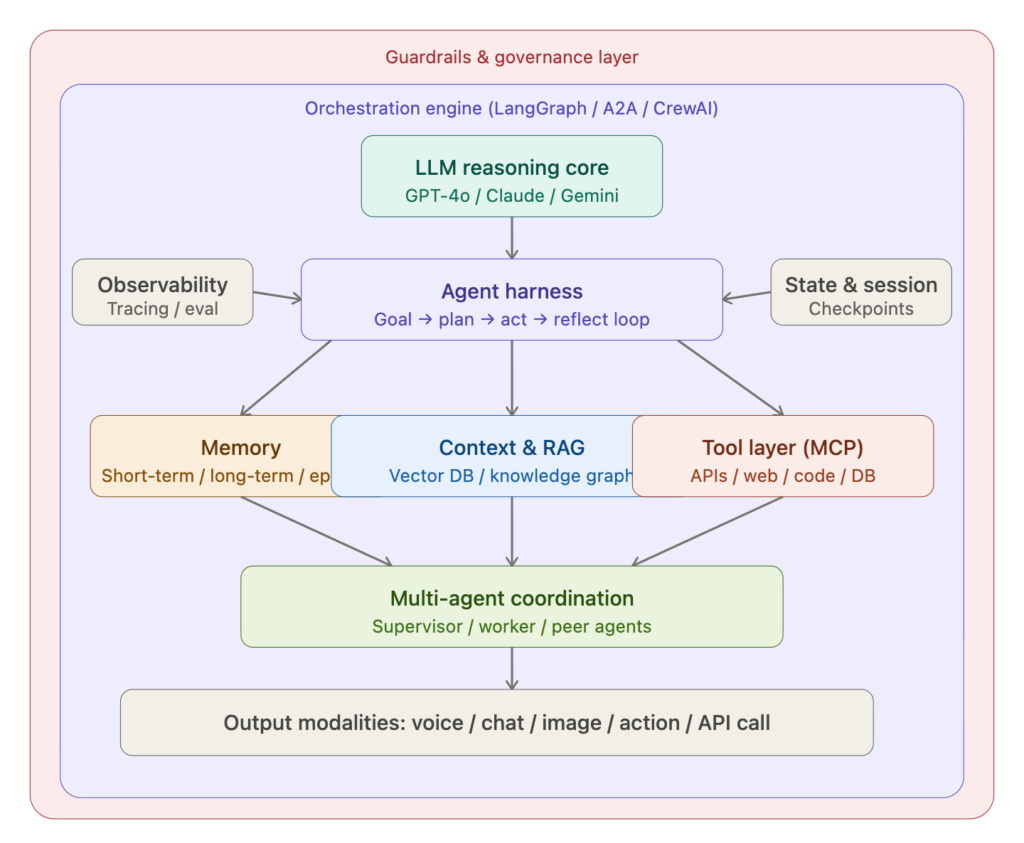
The diagram above maps the generic architecture. Here is what each layer does
and why it matters for startup builders.
– LLM REASONING CORE: The language model (Claude, GPT-4o, Gemini, Llama)
that interprets goals, reasons about context, and generates plans and
outputs.
– AGENT HARNESS (SCAFFOLDING): The control loop wrapping the LLM. Implements
the goal → plan → act → observe → reflect cycle. Agent harnesses /
scaffolding — external engineering layers that work around model
limitations: long-term memory, state handoff, compaction, guardrails, tool
integration, and retry logic.
– MEMORY LAYER (SHORT, LONG-TERM, EPISODIC): Short-term memory holds active
session context. Long-term stores durable facts, preferences, and prior
decisions in vector databases or graph stores. Episodic memory captures
specific experiences for future reference. Bessemer calls this “the key
to the kingdom of enterprise knowledge.”
– CONTEXT & RAG (RETRIEVAL-AUGMENTED GENERATION): Agents dynamically retrieve
relevant knowledge from vector databases, knowledge graphs, and structured
data. Enterprises need “a continuous way to clean, structure,
validate and govern their multimodal data so downstream AI workloads
actually work.”
– TOOL LAYER (MCP): The action interface — connecting agents to APIs,
databases, web browsers, code execution environments, and legacy systems.
Bessemer describes MCP as “a universal specification for AI agents to
access external APIs, tools, and data persistently. Think of it as USB-C
for AI.” This layer is where agents stop being “smart chatbots” and start
being “digital workers.”
– MULTI-AGENT COORDINATION (A2A): Complex tasks decompose across specialized
agents. Enterprises will need systems of coordination:
new layers to manage multi-agent interactions, adjudicate context, and
ensure reliability across autonomous workflows.”
– OBSERVABILITY: Full tracing of every decision, tool call, and failure. Use-case-specific evals built on proprietary
data” — not public benchmarks
– STATE & SESSION MANAGEMENT: Checkpointing enables long-running tasks,
human-in-the-loop approval gates, and graceful failure recovery. Sequoia’s
long-horizon agent framework requires this as a core capability
– GUARDRAILS & GOVERNANCE: The outermost layer. Input/output filtering, prompt
injection detection, tool access controls, content safety, and audit logging.
In regulated industries, this is table stakes.
– OUTPUT MODALITIES: Voice, chat, image, action, and API call — unified.
The browser will emerge as a dominant interface for agentic AI, with voice-first AI products running and optimizing critical parts of every business.
Your competitive moat is NOT the model.
It is the domain expertise, workflow depth, proprietary memory, and the trust
required to operate autonomously in consequential business processes.
PART 4 | INDUSTRY-BY-INDUSTRY: WHERE THE STARTUPS WILL BE BUILT
──────────────────────────
HEALTHCARE & PHARMACY
──────────────────────────
The industry has two problems: administrative overload killing clinicians, and
access barriers killing patients. Agentic AI solves both. Targeting
a specific high-friction workflow with deep AI automation. The global AI in healthcare market is growing from $20.9B (2024) to $148.4B by 2032 at a CAGR of 27.1%.
STARTUP IDEAS:
– Autonomous prior authorization agent: Navigates payer portals, assembles
clinical justification, and submits on behalf of physicians — eliminating
a process costing U.S. healthcare $35B annually.
– Clinical documentation agent: Listens to provider-patient conversations,
generates structured SOAP notes, codes ICD-10 and CPT, files into the EHR.
Ambience Healthcare ($243M, a16z-backed) leads this category.
– Medication adherence companion: Voice agent that proactively checks in
with patients, answers drug interaction questions, refills prescriptions,
and escalates non-adherence to care teams.
– Rare disease diagnostic navigator: Multi-agent system ingesting case
history, literature, and genomic data to surface differential diagnoses —
a genuine second opinion at machine speed.
– Pharmacy benefit negotiation agent: Analyzes formularies, rebate
structures, and utilization patterns to autonomously identify switching
opportunities and generate PBM negotiation briefs.
WHY IT MATTERS: healthcare AI systems operate in a regulated,
high-trust environment — making the compliance layer itself a structural moat
that a new model version cannot dissolve overnight.
──────────────────────────
BANKING & FINANCIAL SERVICES
──────────────────────────
The $1 trillion opportunity is in the legacy back office — KYC, compliance, underwriting,
treasury operations.
Harvey raised $200M at an $11B valuation (led by GIC and Sequoia, March 2026)
— confirming that AI autopilots in professional services command premium
multiples when the domain data moat is real.
STARTUP IDEAS:
– KYC / AML compliance agent: Continuously monitors transactions, cross-
references sanction lists, flags anomalies, generates SAR narratives, and
maintains audit trails — replacing entire compliance operations teams.
– Loan origination orchestrator: End-to-end agent that collects documents,
verifies income and identity, runs credit models, assembles underwriting
packages, and routes for decision — reducing origination cycles from weeks
to hours. JPMorgan reports nearly 30% reduction in consumer banking
servicing costs from its 100+ generative AI tools.
– Treasury and liquidity management agent: Monitors real-time cash positions,
executes sweep transactions, optimizes FX hedges, and surfaces liquidity
forecasts for CFO review.
– Wealth planning agent: Builds personalized financial plans, rebalances
portfolios within defined risk parameters, and identifies tax loss
harvesting opportunities — delivering private wealth management quality
to the mass affluent market.
──────────────────────────
PAYMENTS & FINTECH
──────────────────────────
STARTUP IDEAS:
– Agentic payment rails: Purpose-built infrastructure for agent-to-agent
transactions, with verifiable identity, stablecoin settlement, and
millisecond latency. This is the financial plumbing of the machine economy.
– SMB financial operations agent: Accounts payable, receivable, reconciliation,
and cash flow forecasting run autonomously for small businesses that cannot
afford a finance team.
– Fraud detection and chargeback agent: Real-time transaction analysis,
fraud ring pattern detection, automated dispute response — deployed at
machine speed, not human speed.
– Cross-border payment optimization agent: Analyzes FX rates, correspondent
banking routes, and regulatory requirements in real time for optimal
international payment routing.
──────────────────────────
LOGISTICS & SUPPLY CHAIN
──────────────────────────
Logistics is a prime vertical for “AI-native industrial” companies: logistics companies that deploy AI agents to execute work (not just advise) will dramatically undercut traditional
3PLs and freight brokers.
STARTUP IDEAS:
– Dynamic route optimization agent: Ingests real-time traffic, weather,
border crossing times, and driver HOS data to continuously re-optimize
last-mile and long-haul routes.
– Supplier relationship management agent: Monitors supplier performance,
proactively identifies risk (geopolitical, financial, quality), negotiates
contract renewals, and manages alternative sourcing.
– Customs and trade compliance agent: Prepares and files import/export
documentation, classifies goods under HS codes, calculates duties, and
monitors regulatory changes across jurisdictions.
– Demand sensing and inventory agent: Integrates POS data, external signals,
and promotional plans to autonomously adjust replenishment orders across
a distribution network.
──────────────────────────
AGRICULTURE & AGRITECH
──────────────────────────
The democratization of agronomic expertise via voice-native agentic AI could
have the single largest human impact of any vertical application.
STARTUP IDEAS:
– Crop health monitoring agent: Ingests satellite imagery, drone data, and
soil sensor readings to autonomously identify disease outbreaks, nutrient
deficiencies, and irrigation needs — and execute interventions.
– Precision farming orchestrator: Coordinates autonomous machinery based on
real-time field conditions and agronomic models.
– Agricultural extension agent: Delivers expert agronomic advice in local
languages via voice to smallholder farmers who have never had access to a
trained agronomist. This is the “Age of Abundance” thesis applied to the
500 million smallholder farming families feeding 70% of the developing world.
– Commodity trading and risk agent: Monitors futures markets, weather models,
and crop yield forecasts to advise on hedging strategies for farm operators
and grain cooperatives.
──────────────────────────
ENERGY & UTILITIES
──────────────────────────
The energy transition creates massive compliance, permitting, and operations complexity —
precisely what agentic AI systems can absorb.
STARTUP IDEAS:
– Grid balancing and demand response agent: Autonomously manages energy
dispatch, storage charging/discharging, and demand response programs to
optimize cost and reliability across a distributed grid.
– Renewable energy project development agent: Handles permitting research,
interconnection queue monitoring, environmental impact assessment drafting,
and landowner outreach for utility-scale solar and wind projects.
– Energy audit and efficiency agent: Analyzes smart meter data, building
management system logs, and equipment telemetry to autonomously identify
efficiency opportunities and generate actionable upgrade plans.
──────────────────────────
REAL ESTATE
──────────────────────────
Documents, communications, compliance, and negotiation are all language-dense
— exactly what frontier models now handle well.
STARTUP IDEAS:
– Property acquisition agent: Scans listings, runs comparative market
analysis, models returns, flags zoning and title issues, and schedules
inspections — compressing due diligence from weeks to hours.
– Lease abstraction and management agent: Extracts key terms from commercial
leases, monitors critical date calendars, and manages landlord-tenant
communications.
– Construction project oversight agent: Monitors RFI queues, submittal logs,
schedule updates, and budget variances — proactively surfacing risks and
generating owner reports.
– Real estate lead qualification agent: Voice-native agent handling inbound
buyer and seller inquiries, qualifying intent, and booking appointments.
Voice AI delivers 60–80% cost reduction vs. human call center agents
(Presta, 2026).
──────────────────────────
E-COMMERCE & RETAIL
──────────────────────────
Agentic AI products that learn individual preferences and improve with every interaction, building natural retention and data moats that cannot be replicated by a new model version.
STARTUP IDEAS:
– Autonomous merchandising agent: Monitors sales velocity, competitive
pricing, inventory levels, and margin targets to autonomously adjust
assortment, pricing, and promotional spend.
– Personalized shopping agent: Understands individual customer style, size,
budget, and occasion context to proactively surface relevant products.
– Returns and reverse logistics agent: Manages the full return lifecycle —
label generation, inspection coordination, restocking decisions, refund
processing, and fraud flagging.
– Supplier onboarding agent: Automates the end-to-end supplier qualification
process — document collection, financial verification, compliance screening,
and ERP setup.
──────────────────────────
TECHNOLOGY SERVICES & IT
──────────────────────────
STARTUP IDEAS:
– Autonomous software development agent: Reads requirements, writes code,
generates tests, identifies bugs, and opens pull requests.
– IT operations and incident response agent: Monitors infrastructure alerts,
diagnoses root causes, executes playbooks, and coordinates escalation —
reducing MTTR from hours to minutes.
– Security operations agent: Hunts threats, analyzes logs, correlates signals
across SIEM sources, and generates remediation playbooks autonomously.
a16z’s Joel de la Garza identifies security as a prime vertical: “AI will
automate repetitive cybersecurity tasks, closing the long-standing hiring
gap and freeing security teams for high-value work.”
– Technical documentation agent: Maintains living documentation by monitoring
code changes, API updates, and architectural decisions — always current,
never outdated.
──────────────────────────
CALL CENTERS & CUSTOMER SERVICE
──────────────────────────
This is where agentic AI has moved furthest, fastest. The economics are overwhelming:
$/hour per human agent vs. $ per conversation for a voice AI agent, high cost reduction.
STARTUP IDEAS:
– Domain-specific voice agent: Trained specifically for dental practices, law
firms, HVAC companies, or property managers — domain specialization is the
defensibility. Generic solutions cannot compete.
– Escalation intelligence agent: AI handles Tier 1 resolution autonomously
while routing complex, emotional, or high-value interactions to skilled
human agents with full context pre-loaded.
– Customer success monitoring agent: Proactively monitors usage patterns,
identifies churn risk, triggers outreach, and surfaces expansion
opportunities to account managers.
──────────────────────────
OTHER HIGH-POTENTIAL VERTICALS
──────────────────────────
LEGAL: The entire structure of legal services is being renegotiated.
EDUCATION: Building AI tutors adapting to each
student’s pace in real time. The 1:1 tutoring model that human staffing
ratios make impossible at scale is now achievable via agents.
GOVERNMENT: Government agentic AI is large, slow-moving, and enormously defensible once established.
HR & TALENT: Autonomous recruiting, onboarding coordination, employee
experience monitoring — replacing the most administrative-intensive HR
functions.
INSURANCE: Underwriting agents ingesting satellite imagery, claims history,
and social data to price risk and generate policy documents. WithCoverage
is named by Sequoia as an example of the “autopilot” model working.
PART 5 | THE BUSINESS CASE: WHAT AGENTIC AI ACTUALLY DELIVERS
The commercial case is not speculative. It has a clear quantitative framework
validated by real deployments:
COST REDUCTION
– Eliminate repetitive, rule-based cognitive work.
– Replace or augment call center, back-office, and compliance staff.
– Scale without proportional headcount growth.
– Voice AI agents deliver 60–80% cost reduction vs. human call centers.
– JPMorgan: ~30% reduction in consumer banking servicing costs.
REVENUE GROWTH
– 24/7 availability without shift premiums.
– Hyper-personalized customer experience at scale.
– Faster sales cycles through autonomous lead qualification.
– New market segments previously uneconomical to serve.
– Orange / Nexus: 50% conversion rate increase and $6M+ annual LTV from
a single customer onboarding agent.
PRODUCTIVITY & QUALITY
– PwC: quadrupled productivity in AI-augmented roles.
– Bessemer documents AI companies reaching $100M ARR in 18 months —
previously a 7-year journey.
– Sequoia: best AI startups earning “$1M+ in revenue per employee.”
– IBM AskHR: 11.5M interactions/year, 78% resolution rate, <5% human oversight.
STRATEGIC POSITIONING
– First-mover advantage in verticals where data accumulates as a moat.
– Bessemer: “Vertical AI companies have a unique opportunity to outperform
horizontal AI companies in the early days.”
– Deep integrations create high switching costs — the same dynamic that made
Salesforce and Workday so durable, but with AI compounding the advantage.
PART 6 | HOW NOT TO BUILD AN LLM WRAPPER STARTUP
Every major VC firm is now explicitly warning against the same failure mode:
building a thin wrapper around a foundation model and calling it a startup. The implication: the model is the commodity; the scaffolding, data, and
workflow depth is the moat.
The companies rising are building genuine system integration and domain depth. The ones falling are building polished chat interfaces on top of the latest API.
The specific moats that survive:
DOMAIN DATA MOATS
Build or accumulate proprietary domain data — clinical records (with consent),
legal precedent databases, agricultural sensor data, financial transaction
histories — that make your agent dramatically more accurate than any generic
model. This data cannot be replicated by an AI lab shipping a new model. Unstructured, multimodal enterprise data is the generational opportunity for startups that solve it.
DEEP WORKFLOW INTEGRATION
Embed your agent into existing systems of record — the EHR, ERP, TMS, CRM —
with bidirectional integration that is painful to rip out. The deeper the
integration, the higher the switching cost.
PROPRIETARY MEMORY AND LEARNED PREFERENCES
Build agent memory systems that accumulate and improve over time with each
customer — understanding specific processes, preferences, exceptions, and
edge cases. This institutional memory is a genuine moat, products that
get better the longer someone uses them.
VERTICAL-SPECIFIC ORCHESTRATION
Design multi-agent workflows encoding deep domain expertise — not just LLM
calls, but structured decision logic, regulatory rule engines, clinical
protocols, or financial models. This is the “agent harness” layer and is the core of a defensible application layer business.
TRUST AND COMPLIANCE AS A PRODUCT
In regulated industries, the compliance framework IS the product. Build HIPAA,
SOC 2, FedRAMP, or PCI-DSS certification into your architecture from day one.
OUTCOME-BASED PRICING
Companies that price on outcomes — cost per resolved ticket, cost per
closed loan, cost per passed audit — are structurally different businesses
from SaaS tool vendors. The pricing model signals the product architecture.
The question to ask: “What happens to this product when Claude 5 ships?” If
the answer is “it gets better because we plug in the new model as the reasoning
core while our data, integrations, and workflows remain intact” — that is a
real business. If the answer is “it becomes obsolete” — that is an LLM wrapper
on borrowed time.
PART 7 | REIMAGINING PRODUCT DELIVERY ACROSS VOICE, CHAT, AND IMAGE
VOICE-NATIVE AGENTS
Multilingual voice agents
THE BROWSER AS AGENT INTERFACE
MULTIMODAL INTELLIGENCE
Agents that can read medical images, analyze satellite farm photos, inspect
construction drone footage, or process financial documents add a perceptual
dimension unavailable to text-only systems.
UNIFIED AGENTIC INTERFACES
The endpoint is a single AI interface that a business deploys once — handling
voice calls, chat messages, image-based reports, and system actions with
consistent context, memory, and identity.
PART 8 | BENEFITS, RISKS, AND SURVIVAL ODDS: THE HONEST TABLE
DIMENSION BENEFITS RISKS
━━━━━━━━━━━━━━━━━━━━━━━━━━━━━━━━━━━━━━━━━━━━━━━━━━━━━━━━━━━━━━━━━━━━━━━━━━━━━━
MARKET – 48% of global VC in 2025 went – Gartner: 40% of agentic
OPPORTUNITY to AI/LLM; agentic gets the deployments canceled
largest share (Tracxn: $24.2B by 2027 (rising costs,
cumulative, 143% YoY in 2026) unclear value, poor
– Bessemer: AI companies hit risk controls)
$100M ARR in 18 months vs – Sequoia warns of
7 years for legacy SaaS “delays” in both data
– Sequoia: “$0 to $1B club” center buildouts and
emerging in 2026 AGI timeline that may
slow enterprise adoption
COMPETITIVE – Vertical specialists show 3-5x – a16z: “New apps are
POSITION better retention than horizontal rising and falling very
tools (Bessemer) quickly” — the category
– Domain + compliance moat is highly dynamic
makes for defensible – Sequoia “innovator’s
enterprise contracts dilemma”: copilot
– Outcome-based pricing creates companies moving to
alignment with customer success autopilot “cut their
– Deep integrations = high own customers out of
switching costs doing it”
– First-mover data accumulation
compounds with scale
TECHNICAL – Modular, model-agnostic – LLM hallucination in
architecture protects against production remains real
model obsolescence – Sequoia: “agents still
– MCP/A2A open standards reduce fail — they hallucinate,
integration burden lose context, and
– Agent harness / scaffolding charge confidently down
is the real innovation layer exactly the wrong path”
– Observability tools maturing – “Agent-speed workloads
– Bessemer: private eval are massively concurrent,
frameworks unlock enterprise recursive, and bursty —
trust and 10x deployment current systems mistake them for attacks”
FINANCIAL – High margins on software- – Enterprise sales cycles
– delivered agent work remain long (6-18 months)
– Outcome-based pricing commands – Inference costs for
premium vs. seat-based SaaS complex multi-agent
– Bessemer’s Q2T3 archetype: systems are material
durable 60%+ gross margins – Bessemer warns of
– Sequoia: $1M+ revenue per “Supernova vs. Shooting
employee at best AI companies Star” trap — fast growth
with fragile retention and thin margins
REGULATORY & – Compliance as structural – GDPR, HIPAA, EU AI Act,
COMPLIANCE competitive advantage in and state AI legislation
regulated verticals are evolving rapidly
– Early movers shape with unresolved liability
compliance norms and become – Mandatory human oversight
the reference implementation requirements in high-
– Government deployments stakes domains add
create large, sticky contracts friction and cost
– Bessemer: trusted private evals – Data residency
as “deployment gate” = moat requirements complicate global scaling
TALENT – AI-native talent increasingly – Competition from
accessible globally OpenAI, Anthropic,
– a16z: most of the AI Google for top engineers
opportunity is outside Silicon – Rapid skill obsolescence
Valley — founding teams in requires continuous
traditional verticals have learning investment
the domain expertise VCs lack – Founder dependency risk
– $1M+ revenue per employee at in early-stage companies
best AI companies is real
SURVIVAL ODDS HIGHEST PROBABILITY LOWEST PROBABILITY
(2-5 YEAR – Vertical autopilots with – Thin LLM wrappers
HORIZON) domain data moats with no proprietary
– B2B with deep workflow data or integration
integrations and compliance – Generic horizontal
– Outcome-based pricing model copilots in markets
– Healthcare, legal, finance, where Big Tech has
logistics with regulatory native agents
barriers – Consumer-facing agents
– Companies acquired vs. competing directly
replaced (proprietary training with ChatGPT and
data is the acquisition signal) Gemini native features
BOTTOM LINE: Long-horizon agents have crossed the threshold from assistants into
autonomous workers — the era of passive chatbots is definitively over. Vertical
agentic AI companies with genuine workflow depth and domain expertise are
positioned to outperform generic horizontal platforms in both retention and
revenue durability. The category has not yet consolidated — massive white space
remains across every industry vertical. The startups that will define this era
are being founded right now, and the window to build a defensible position is
still open.
PART 9 | THE VC CONSENSUS: WHAT THE SMARTEST MONEY IS SAYING
This is no longer fringe optimism. The institutional consensus from the firms
that have collectively deployed hundreds of billions into technology is
remarkably unified:
A16Z (ANDREESSEN HOROWITZ)
– “AI is eating software.” The firm’s entire investment thesis has shifted.
– Big Ideas 2026: “Interfaces shift from chat to action.” Voice, agents,
and agentic execution define the next wave.
– Jennifer Li: Unstructured enterprise data is a “generational opportunity.”
– Seema Amble: The shift from copilots to end-to-end agents is inevitable
as model capability improves.
– Investment focus: Healthcare (40% of 2025 AI portfolio), infrastructure,
vertical autopilots. Key bets: Cursor, Harvey, Sierra, Hippocratic AI,
Ambience, ElevenLabs, Glean, Decagon.
SEQUOIA CAPITAL
– “Services: The New Software” — the most commercially actionable VC thesis
of 2026. A copilot sells the tool. An autopilot sells the work.
– “2026: This Is AGI” — long-horizon agents are functionally AGI; “2026 will
be their year.” The Don Valentine test: “Can you hire it?”
– Sonya Huang’s “Age of Abundance” thesis: AI makes once-scarce labor
available everywhere at near-zero cost.
– Key investments: Harvey ($200M, $11B valuation, March 2026), Glean, Cursor
(Anysphere), LangChain, Rogo.
– Market prediction: “The $0 to $1B club” emerging in 2026 for the best
agentic AI companies.
BESSEMER VENTURE PARTNERS
– State of AI 2025: “Three years after the AI Big Bang, early galaxies are
forming.” Vertical AI companies have a structural advantage.
– Two archetypes: “Supernovas” (fast growth, fragile) vs. “Shooting Stars”
(durable, 60%+ margins). Build for durable.
– MCP is “USB-C for AI.” The browser is the dominant agentic interface.
– Private evaluation frameworks will “10x enterprise deployment” in 2026.
– Prediction: incumbents will “aggressively acquire AI-native startups” —
plan your exit accordingly.
– Key investments: Anthropic, Cursor, SmarterDx, Fieldguide, Jasper, Plenful.
GENERAL CATALYST
– “Building the rails for the machine-to-machine economy.” (Marc Bhargava,
on Kite investment)
– Investment thesis: AI agents need identities, programmable governance, and
seamless payment flows to operate at internet scale.
– YC + GC backing of Nexus (March 2026) with the thesis: “Enterprises don’t
need another AI assistant — they need an AI agent that completes work
reliably and delivers measurable results from the start.”
– Orange deployment via Nexus: 50% conversion increase, $6M+ LTV,
10+ point increase in customer satisfaction. Four weeks to production.
– Key focus: Healthcare (Health Assurance Fund), enterprise SaaS, fintech.
Y COMBINATOR (WINTER 2026 DEMO DAY)
– “Agentic AI is not a feature, not a department — it is the operating layer
of the next enterprise stack.” (DynamicsFocus analysis)
– YC W26 themes: agentic cybersecurity, data infrastructure, vertical
automation. Companies achieving $1M+ ARR in under 8 weeks.
– The signal: institutional investors are “fighting over cap tables” for
agentic AI applications in specific verticals.
INSIGHT PARTNERS
– Led Wonderful AI’s $150M Series B (March 2026) with the thesis: “AI agents
are infrastructure, not features. They’re not add-ons to existing SaaS.
They’re platforms that replace workflows.”
– Led Legora’s $550M Series D at $5.55B valuation — alongside Bessemer, IVP,
and Index Ventures — confirming that legal AI autopilots command premium
multiples.
THE CONVERGENT MESSAGE:
Every one of these firms is saying the same thing with different words:
1. The model is infrastructure. The application layer is where founders win.
2. Vertical specialization beats horizontal generality.
3. Autopilots (sell the work) beat copilots (sell the tool).
4. Domain data, workflow integration, and compliance are the durable moats.
5. The window is open now. It will not be open forever.
THE CLOSING ARGUMENT: BUILD THE FUTURE, DON’T WAIT FOR IT
The real test for the agentic AI era: “Can you hire it?”
In 2023, you couldn’t. In 2024, you could hire it for narrow tasks. In 2026,
you can hire an agent that navigates a 31-minute recruiting search, manages
an end-to-end loan origination, handles clinical documentation across a health
system, or processes 11.5 million HR requests per year with 78% autonomous
resolution. That is a fundamentally different capability than a chatbot.
Every industry described in this article has a version of this question:
“What if the most capable, knowledgeable professional in this domain could
work 24/7, across every customer simultaneously, in any language, without
vacation, at a fraction of current cost, while continuously improving?”
That is not science fiction. That is the product description of a well-built
agentic AI autopilot in 2026.
a16z, Sequoia, Bessemer, and General Catalyst are not writing thought leadership
for entertainment. They are describing where their next billion-dollar returns
will come from. The founders who read those theses, understand their domain,
build the right architecture, and find the right enterprise buyers will join
them.
The companies that will define the next decade of enterprise software are being
founded right now. They are being built by founders who understand that the LLM
is infrastructure — and that the real value is in the domain expertise, the
workflow depth, the proprietary data, and the trust required to operate
autonomously in consequential business processes.
At IndusAgentAI, we believe agentic AI is not a threat to human economic activity.
It is the most powerful amplifier of human capability ever built. The founders
who deploy it responsibly — with genuine domain understanding, real architectural
depth, and honest attention to human impact — will create companies, careers,
and industries that we cannot yet fully imagine.
The window is open. Build something that matters.
ABOUT INDUSAGENTAI
IndusAgentAI.com is a platform dedicated to agentic AI innovation — exploring
the architecture, business models, and real-world deployment of autonomous AI
systems across industries. For founders, architects, and enterprise leaders
navigating the agentic AI transition.
PRIMARY VC SOURCES
a16z (Andreessen Horowitz):
– “Big Ideas 2026: Part 1 & Part 2” (December 2025) — a16z.com
– “Big Ideas 2026: The Agentic Interface” podcast (December 2025)
– “AI Speedrun: 14 Big Ideas for 2026” (December 2025)
– “The AI Application Spending Report” — Moore, Andrusko, Amble (2025)
– “Top 100 Gen AI Consumer Apps” — Olivia Moore, Anish Acharya (2025)
– “Humans Are for Ideas, AI Is for Execution” — Olivia Moore
Sequoia Capital:
– “2026: This Is AGI” (January 2026) — sequoiacap.com
– “Services: The New Software” (March 2026) — sequoiacap.com
– “AI in 2026: A Tale of Two AIs” (December 2025) — sequoiacap.com
– Sonya Huang, AI Ascent 2025 keynote: “The Age of Abundance”
– “AI in 2025: Building Blocks Firmly in Place” (December 2024)
Bessemer Venture Partners:
– “The State of AI 2025” — Dholakia, Droesch, Moore (August 2025) — bvp.com
– “Roadmap: AI Systems of Action” — bvp.com
– “Part I & II: The Future of AI Is Vertical” — bvp.com
– “Bessemer’s AI Agent Autonomy Scale” — bvp.com
– “State of Health AI 2026” — bvp.com
General Catalyst:
– “Our Investment in Kite” — generalcatalyst.com (September 2025)
– Nexus seed investment announcement (March 2026)
– Hemant Taneja: “Applied AI and Resilience” investing thesis
Additional VC & Research Sources:
– Insight Partners: Wonderful AI Series B analysis (March 2026)
– Y Combinator: Winter 2026 Demo Day analysis (April 2026)
– Prosus / Dealroom: “The Rise of the Agentic Workforce” (2025)
– Tracxn: Agentic AI Sector Report (April 2026)
– Kore.ai: Agentic Architecture — Blueprint for Intelligent Enterprise (2026)
– Prosus / Dealroom.co — “The Rise of the Agentic Workforce” (2025)
– Tracxn Agentic AI Sector Report (April 2026)
– Goldman Sachs Research — “How Will AI Affect the Global Workforce?” (2025)
– World Economic Forum — Future of Jobs Report 2025
– McKinsey Global Institute — Scaling Agentic AI with Data Transformations
– Deloitte Insights — Autonomous Generative AI Agents (2025)
– Bain & Company — The Three Layers of an Agentic AI Platform (2026)
– ITIF — “AI’s Job Impact: Gains Outpace Losses” (December 2025)
– ILO — World Employment and Social Outlook 2025
– Google Cloud — Agentic AI Architecture Components Documentation
– Neo4j — Agentic AI Architecture: Patterns and When to Use Them
– Akka — Agentic AI Frameworks for Enterprise Scale: A 2026 Guide
– PwC — 2025 Global AI Jobs Barometer
– StartUs Insights — 10 AI Agent Startups to Watch in 2026
– Presta — AI Agent Startup Ideas That Made $1M+ in 2026
– Linas Beliūnas Newsletter — Agents 20: Top AI Agent Startups of 2025
– Gartner — Enterprise AI and Agentic Adoption Forecasts
– Nextgov/FCW — 2026 Is Set to Be the Year of Agentic AI (December 2025)
– SSRN — AI Job Displacement Analysis 2025-2030 (Nartey, 2025)