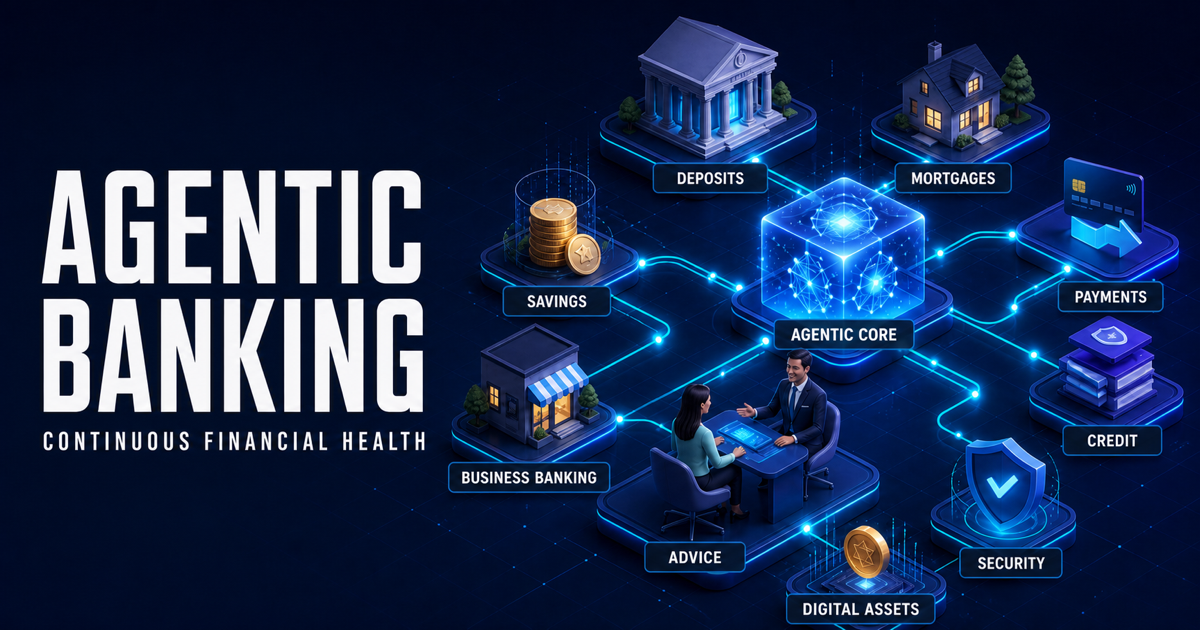
Agentic Banking: From Selling Financial Products to Delivering Continuous Financial Health
How governed AI agents can modernize deposits, payments, credit, mortgages, business banking, wealth and the regulated machinery behind them.
Banking is the operating system of economic life. It stores value, moves money, bridges time and allocates credit. Agentic AI can make that system more responsive, affordable and human—but only when agents complete useful work within law, consent, security and accountable human leadership.
Explore the article
- Executive summary
- Part I — Why banking needs a new operating model
- 1. Banking’s essential role and public compact
- 2. The banking product and customer map
- 3. Six customer problems—and the opportunity inside them
- Part II — How agentic banking actually works
- 4. The agentic banking operating architecture
- 5. Product-by-product transformation
- Part III — Three journeys that prove the model
- 6. Three journeys that prove the model
- Part IV — Startups, new products and digital infrastructure
- 7. Where startups fit
- 8. Agentic-native products and services
- 9. Crypto, stablecoins and tokenized banking
- Part V — Workforce augmentation and economic value
- 10. Workforce augmentation and economic value
- Part VI — Trust, law and regulated deployment
- 11. Six essential risks
- 12. Regulation made operational
- Part VII — A disciplined transition
- 13. A six-stage transition
- 14. Eight investment and leadership questions
- Conclusion: banks and startups can rebuild banking together
- Selected research and source guide
Executive summary
Banks and credit unions are essential infrastructure. They safeguard deposits, move money, finance homes and businesses, support capital markets and help people build long-term security. U.S. insured institutions entered 2026 with strong capital and liquidity and earned $80.5 billion in the first quarter. The issue is not whether banking creates value. It is whether that value can be delivered with less administrative friction and greater benefit to customers. FDIC Quarterly Banking Profile, Q1 2026
Customers still encounter high and difficult-to-compare prices, slow decisions, fragmented service, outdated credit signals, fraud-recovery burdens and products that rarely work together. Credit-card consumers were assessed approximately $190 billion in interest and fees in 2024 when the CFPB’s underlying figures are rounded—about $160 billion in interest and $31.3 billion in fees. CFPB, The Consumer Credit Card Market 2025 Banks understand many of these problems, but they must modernize without destabilizing ledgers, violating regulation or weakening public trust. Legacy platforms, acquired systems, product silos and cautious governance make even sensible change difficult.
Agentic AI creates a new option. A governed agent can understand an objective, retrieve authorized context, maintain case memory, reason and plan, use tools, complete reversible actions, verify results and escalate consequential judgment. It can stay with a customer problem across channels and departments instead of generating another answer and leaving the customer to carry the workflow.
This creates opportunities for both institutions and startups. Banks contribute regulated authority, capital, risk expertise, trusted records, distribution and customer relationships. Startups contribute focus, speed, modern architecture and freedom to rebuild narrow processes. They can compete, but they can also partner through enterprise software, bank sponsorship, white-label products, strategic investment, joint ventures and acquisition. Many of the strongest outcomes will combine their complementary advantages.
The goal is not autonomous banking or headcount reduction. It is a more capable banking system: employees freed from repetitive work; customers receiving faster and clearer help; small firms gaining financial capabilities they could not previously afford; banks generating new products and revenues; and regulators receiving better evidence. The winner will not be the institution with the most agents. It will be the institution that redesigns the right processes and proves that every agentic action creates more value than it costs. This is where banks and startups can combine their complementary strengths to rebuild a banking system that is more capable, accessible and trusted—and works better for everyone.
Part I — Why banking needs a new operating model
1. Banking’s essential role and public compact
Banking makes time and distance negotiable. Depositors exchange immediate use of money for safety, access and sometimes yield. Borrowers bring future income forward to purchase a home, vehicle or productive asset. Businesses convert sales into cash, finance inventory and pay workers. Payment systems allow strangers to exchange value, while securities, custody and advisory businesses connect savers with long-term investment.
“Banking” therefore includes different institutions and legal roles: national and state banks, community banks, credit unions, card issuers, payment companies, trust companies, custodians, broker-dealers, advisers, asset managers and fintech distributors. A customer may see one brand while deposits, lending, payments and servicing are performed by several entities. Agentic systems can coordinate that experience, but they cannot erase the legal boundary or authoritative record of each participant.
Public support creates public expectations
Banking operates through a public–private compact. Charters confer authority. Deposit insurance protects covered depositors. Central-bank liquidity supports eligible institutions during funding stress. Public and private payment systems underpin commerce. In return, banks accept capital, liquidity, consumer-protection, community, financial-crime and supervisory obligations.
This support should be described accurately. The FDIC’s Deposit Insurance Fund is primarily financed by risk-based assessments on insured institutions and interest on Treasury securities, while the federal guarantee supplies essential public credibility. FDIC, Deposit Insurance Fund Federal Reserve discount-window lending is collateralized and generally priced above comparable market funding; it is a backstop rather than routine free financing. Federal Reserve, Discount Window FAQ Extraordinary crisis support and “too big to fail” expectations have nevertheless been real policy concerns. Treasury invested $245.5 billion through TARP bank programs and had recovered $275.9 billion by September 2023, while GAO found that crisis-era funding advantages declined after reforms but could not be measured with certainty. U.S. Treasury, TARP Bank Investment Programs, GAO, Large Bank Holding Companies
The balanced conclusion is not that banks receive universally easy or free money. It is that banking benefits from public architecture unavailable to ordinary businesses. Society can reasonably expect this architecture to produce resilience, fair competition, wider access and improving customer service.
Profit and customer value can grow together
Healthy earnings help banks absorb losses, invest and raise capital. FDIC-insured institutions earned $295.6 billion in 2025 and $80.5 billion in the first quarter of 2026. FDIC Quarterly Banking Profile, Q1 2026 Profit is not itself evidence of customer harm. The strategic question is whether revenue comes from useful intermediation and trusted service or from avoidable opacity, friction and customer inertia.
Agentic banking can improve both sides: lower the fixed cost of service, prevent losses, create more useful products and give employees capacity to deepen relationships. Some gains should appear as better prices, faster resolution and wider access; otherwise modernization will not strengthen public trust.
2. The banking product and customer map
The word “banking” hides a large product system. A useful transformation begins with the outcome each customer is trying to achieve.
| Product family | Representative products and services | Outcome the customer actually wants |
|---|---|---|
| deposits and cash | checking, savings, money-market deposits, certificates, sweeps, escrow and cash management | safe liquidity, yield and reliable records |
| consumer payments | debit and credit cards, ACH, wires, checks, bill pay, P2P, wallets, instant payments and remittances | exchange value safely, quickly and predictably |
| merchant services | acquiring, gateways, terminals, settlement, tokenization, chargebacks and fraud tools | convert a sale into usable cash |
| consumer credit | cards, auto, personal, student, point-of-sale, secured credit and overdraft | bridge income and consumption at a sustainable cost |
| home finance | purchase and construction mortgages, refinance, home equity, escrow and servicing | obtain and keep a home while building equity |
| small-business banking | accounts, cards, working-capital lines, term loans, SBA-supported lending and equipment finance | maintain liquidity, invest and survive volatility |
| commercial banking | revolvers, term debt, syndicated loans, asset-based lending and commercial real estate | finance operations, transactions and capital assets |
| treasury and trade | receivables, payables, payroll, liquidity, FX, hedging, letters of credit and trade finance | control cash, settlement and financial risk |
| investment banking and markets | issuance, M&A, underwriting, research, market making, prime brokerage and derivatives | raise capital, obtain liquidity and transfer risk |
| wealth and asset management | brokerage, planning, managed portfolios, retirement, trusts, funds and private banking | translate assets into life goals and long-term security |
| custody and asset servicing | custody, clearing, collateral, corporate actions, fund administration and settlement | preserve ownership and market integrity |
| public and institutional banking | municipal deposits, public finance, correspondent banking and infrastructure finance | keep essential institutions funded and operating |
Households need simplicity, affordability and help during life events. Small companies need cash visibility and finance capability without hiring a treasury department. Large organizations need control across volume, entities and jurisdictions. Communities need inclusion, productive credit, financial integrity and continuity through shocks. Agentic systems become valuable when they coordinate these outcomes without weakening product-specific law or accounting.
3. Six customer problems—and the opportunity inside them
| Customer or operating problem | What customers experience | Why it persists | Agentic opportunity |
|---|---|---|---|
| high and difficult-to-compare prices | interest, fees and add-ons that are understood after use | complex terms, segmentation and inertia | personalized total-cost comparison, pre-fee warnings and suitable alternatives |
| uneven deposit value | low yield, excess idle cash or balances in the wrong account | relationship pricing and passive product management | continuous liquidity, yield and insured-balance optimization within customer preferences |
| incomplete credit assessment | thin-file applicants, opaque declines and products poorly matched to capacity | static files, fragmented cash-flow evidence and old decision processes | permissioned evidence assembly, affordability testing and specific credit pathways |
| fragmented service and legacy systems | repeated authentication, missing state and slow correction | disconnected ledgers, product processors, workflow and acquired platforms | one governed case that coordinates tools, teams, deadlines and verified completion |
| fraud and dispute friction | scams, false declines, account freezes and repeated proof | identity, transaction, network and service signals remain separated | intent verification, contextual intervention and end-to-end recovery orchestration |
| small-business and inclusion gaps | smaller accounts receive less advice or expensive credit | high fixed cost per case and limited staff capacity | affordable finance operations, application preparation and relationship-manager leverage |
Price and deposits
The CFPB reported average 2024 APRs of 25.2 percent on general-purpose cards and 31.3 percent on private-label cards, alongside approximately $160 billion in interest and $31.3 billion in fees. CFPB, The Consumer Credit Card Market 2025 Prices reflect credit risk, rewards, fraud, capital and funding, but customers should see expected dollar cost and a safer alternative before committing. An agent can calculate that path continuously rather than advertise another product.
Deposit competition is similarly uneven. Banks in a Federal Reserve survey reported an average retail-deposit beta near 40 percent during a period when the policy rate rose 525 basis points, compared with higher betas for wholesale funding. Federal Reserve Senior Financial Officer Survey A governed agent can optimize liquidity and yield across approved accounts while respecting insured limits, upcoming obligations and relationship preferences.
Credit and service
The Federal Reserve estimates that approximately 32 million adults are credit invisible or have records too thin to score conventionally. Cash-flow evidence can improve access, but alternative data must be permissioned, relevant, stable and fair. Federal Reserve, Consumer & Community Context, October 2025 A useful agent assembles evidence and explains an achievable pathway; it does not replace an old opaque score with a more invasive opaque score. Creditors using complex algorithms still must provide accurate, specific adverse-action reasons. CFPB Circular 2022-03
Service problems often come from fragmented state rather than uncaring employees. An agent can authenticate once, retrieve the timeline, coordinate the responsible team and verify that a correction reached every system. It should be a bridge toward simpler architecture—not a permanent layer that hides incoherent processes.
Fraud, small firms and inclusion
Twenty percent of adults reported experiencing financial fraud or scams in 2025. Federal Reserve, Economic Well-Being of U.S. Households in 2025 Banks must intervene quickly without turning probabilistic suspicion into an unexplained freeze. Agents can combine context, deliver precise warnings, prepare disputes and coordinate recovery while payment rights and liability remain deterministic.
Small firms frequently have viable operations but fragmented records and no finance staff. The 2026 Small Business Credit Survey found that small-bank applicants were more likely to report full approval, while 60 percent of online-lender borrowers said actual cost was higher than expected. Federal Reserve Banks, 2026 Report on Employer Firms Agentic preparation can preserve relationship judgment while lowering the cost of serving a small account. That matters in a country where 4.2 percent of households remained unbanked in 2023 and useful inclusion still extends beyond account ownership. FDIC Economic Inclusion
Part II — How agentic banking actually works
4. The agentic banking operating architecture
Digital banking placed products on a screen. Conversational AI made information easier to request. Agentic banking gives software responsibility for moving a bounded objective toward verified completion.
The operating loop
Observe → Understand → Reason and plan → Act → Verify → Learn → Escalate to HITL (human in the loop)
This loop adapts the ReAct pattern—reasoning interleaved with tool use—to a regulated environment. ReAct is useful because it translates a disciplined form of human problem-solving into an agent: observe evidence, reason about the next step, act, inspect the result and revise rather than committing to one untested answer. The agent retrieves evidence, chooses the next authorized step, observes the result and updates the case. “Learning” means governed case memory, evaluated feedback and approved system improvement; it does not mean uncontrolled retraining on customer activity.
| Architecture layer | What it does | Banking example | Essential control |
|---|---|---|---|
| goal and role | defines whose outcome the agent serves | resolve a customer’s card dispute rather than minimize bank payout | declared principal, purpose and conflicts |
| context | retrieves authorized facts, documents, policies and history | transactions, call record, network rules and dispute deadline | least-privilege access and source hierarchy |
| memory | maintains time-stamped case state | what was submitted, decided, missing and promised | retention, correction and separation of fact from inference |
| reason and plan | decomposes the objective and selects the next step | decide whether to request evidence, calculate or escalate to HITL | approved workflow, confidence threshold, policy retrieval and mandatory human-review triggers |
| tools and actions | searches, calculates, requests, schedules, routes, updates or executes | send an approved request, run an affordability service or move funds within a mandate | allow-listed tools, authentication and hard transaction limits |
| guardrails | constrains data, authority, communication and money | prevent a new-payee transfer without independent approval | controls outside the language model |
| observability, HITL and leadership | records actions, monitors results and identifies the accountable human | show why the agent acted, what changed, what was escalated and who approved it | end-to-end traces, live monitoring, rollback, stop controls and authenticated HITL handoff |
“Escalate” is an explicit handoff to a human in the loop, not an error message. Uncertainty, policy conflicts, vulnerable-customer signals, exceptions and consequential decisions must arrive with the relevant evidence, agent reasoning and proposed next step so an authorized person can review, override or stop the workflow. The agent can coordinate the case, but people continuously monitor the system and retain control of consequential judgment. Authoritative balances, contractual terms, interest, entitlements and limits remain in deterministic systems; a model should never improvise a ledger entry or legal right.
A compact hardship workflow
A mortgage-hardship agent can recognize an authenticated request, assemble loan and payment context, retrieve current assistance rules, calculate options through approved services and prepare a complete case. It may schedule, request missing evidence and send authorized notices, but a qualified employee owns contested facts, adverse decisions and vulnerability. The agent then monitors deadlines and verifies that an approved change posted correctly.
This is the practical difference between answering and completing. The customer does not have to reconstruct the process at every handoff, and the employee receives a coherent case rather than another unstructured conversation.
A visible permission envelope
Authority should be expressed as purpose, permitted data, allowed tools, monetary and time limits, reversibility and escalation. Four bands are enough for most deployments:
| Band | Agent responsibility | Example |
|---|---|---|
| prepare | retrieve, compare, calculate and draft | produce a cited commercial-credit brief |
| act reversibly | request, schedule, prefill, tag and route | obtain a missing KYC document |
| execute within a mandate | take a preauthorized deterministic action | sweep money between named accounts inside customer-set bands |
| HITL decision required | stop and route a complete decision packet to an authorized person | new credit, adverse action, suspicious-activity escalation or disputed liability |
A prompt saying “do not move more than $500” is an instruction. A payment service that technically refuses $500.01 is a guardrail.
Five safety questions
Before production, an owner should answer:
- What customer or employee outcome does the agent own, and whose interest does it serve?
- Which facts, policy versions and calculations support each action?
- What can the agent do, and what technically prevents action outside its mandate?
- How does it perform on ordinary, adversarial, vulnerable and system-failure cases?
- Who can stop, correct and appeal the result?
NIST’s voluntary AI Risk Management Framework and generative-AI profile provide useful cross-sector governance language, but banking law and institutional controls still govern the action. NIST Generative AI Profile
5. Product-by-product transformation
The value of an agent appears when a persistent problem requires context, multi-step work, tools and follow-through. The table below maps that value explicitly.
| Banking domain | Current customer or operating problem | Agentic workflow and actions | Measurable benefit | Governance, security and regulatory guardrails |
|---|---|---|---|---|
| deposits and cash | customers miss upcoming obligations, pay avoidable fees or leave money idle | forecast cash, detect recurring leakage, maintain a chosen buffer, optimize approved balances and verify sweeps | fewer overdrafts, higher realized yield, better liquidity and stronger retention | explicit mandate, insured-balance logic, named accounts, transfer caps, authentication and revocation |
| cards and payments | scams, false declines, fragmented disputes and merchant reconciliation breaks | verify intent, intervene contextually, assemble evidence, route network actions and monitor recovery | lower fraud and false positives, faster disputes and fewer repeat contacts | Regulation E and network rights, independent confirmation, payee limits, sanctions, deterministic settlement and appeal |
| consumer credit | thin files, repetitive applications, opaque declines and late hardship response | assemble permissioned cash flow, verify documents, model affordability, prepare specific reasons and monitor stress | faster decisions, wider responsible access, fewer avoidable losses and clearer pathways | ECOA, Regulation B, FCRA, permitted data, disparity testing and human adverse-action review |
| mortgages | document chasing across origination, title, appraisal, insurance, closing and servicing | maintain one requirements graph, reconcile evidence, coordinate parties, track conditions and continue into servicing | shorter cycle, fewer failed closings, lower rework and earlier assistance | TILA, RESPA, fair lending, source lineage, valuation challenge and human foreclosure/exception decisions |
| small-business banking | owners lack cash visibility and smaller applications are expensive to serve | reconcile accounts and invoices, maintain a 13-week forecast, prepare financing evidence and monitor covenants | affordable finance capability, more qualified applications and better relationship-manager reach | owner consent, no fabricated forecast, transparent compensation and banker credit authority |
| commercial lending and treasury | periodic reviews miss change; teams spend time spreading, reconciling and chasing exceptions | spread statements, research context, monitor covenants, forecast liquidity, match receivables and prepare trade or hedge actions | earlier risk visibility, lower trapped cash and more employee time for structure and negotiation | dual control, approved counterparties, instruments and limits; no automatic rating or commitment |
| financial crime | investigators reconstruct entities and close large volumes of false positives | resolve entities, gather KYC/KYB evidence, build chronologies, investigate alerts and draft cited narratives | more capacity for real networks, quicker onboarding and better evidence | BSA/AML, sanctions, protected SAR procedures, access restriction and human account action |
| wealth and retirement | continuous planning is expensive and advisers spend time on administration | prepare meetings, consolidate goals, model distributions, monitor drift and coordinate service | wider advice access, stronger adviser relationships and better retention | fiduciary and suitability duties, compensation disclosure, approved communications, records and trading authority |
| markets, custody and asset servicing | diligence, trade and corporate-action exceptions consume specialist time | synthesize research, track deal conditions, investigate breaks, reconcile collateral and prepare corporate actions | faster analysis and more reliable market plumbing | information barriers, market-conduct rules, approvals, entitlements and authoritative ledgers |
Part III — Three journeys that prove the model
6. Three journeys that prove the model
Bank products are local; customer problems are end to end. These journeys show why an agent must maintain context and progress across systems rather than optimize one transaction.
Journey one: household financial health
A household agent can:
- Map income, obligations, rates, fees and available liquidity.
- Forecast upcoming pressure and warn before a shortfall.
- Compare repayment, saving and refinancing paths with visible tradeoffs.
- Execute only approved transfers inside a customer mandate.
- Monitor results and bring a banker or adviser into consequential decisions.
The customer gains continuous guidance instead of disconnected product dashboards. The bank gains retention, appropriate lending and fewer preventable service events. Compensation and optimization criteria must remain visible so “financial health” does not become disguised cross-selling.
Journey two: the small-business finance desk
For a business facing a seasonal funding gap, an agent can:
- Reconcile orders, invoices, bank activity, payroll and accounting.
- Maintain a probability-weighted 13-week cash forecast.
- Identify the date, size and cause of a financing need.
- Compare credit, invoice finance, supplier terms and owner capital.
- Assemble verified evidence and monitor the chosen facility after approval.
This turns fragmented operating data into a finance capability the owner could not otherwise afford. It also allows a relationship manager to serve more companies without reducing judgment. The owner makes commitments and the banker owns underwriting.
Journey three: fraud prevention and recovery
When a customer is manipulated into sending money, an agent can:
- Join device, payee, transaction and interaction signals.
- Deliver a contextual warning and verified callback.
- Apply only policy-authorized delay or confirmation.
- Capture the customer’s story once and coordinate recovery evidence.
- Track receiving-bank communication, liability review and customer updates.
Speed matters before settlement; empathy, law and clarity matter afterward. The agent should preserve evidence and coordinate action, while people own contested liability and vulnerability.
Part IV — Startups, new products and digital infrastructure
7. Where startups fit
Startups can move quickly because they are small, focused and free to redesign a narrow workflow. They do not inherit decades of product systems or committee structures. Their constraint is equally important: they usually lack a charter, licenses, balance sheet, customer trust and authority to move money or make regulated decisions.
The best entry point is therefore a valuable agentic workflow whose authority can be bounded clearly.
The opportunity map
| Opportunity | Broken workflow | Agentic activity or workflow | Representative builders | Benefit |
|---|---|---|---|---|
| KYC and business onboarding | analysts search documents and re-request evidence | resolve entities, gather sources, identify gaps and prepare a cited case | Parcha, Arva AI, Alloy | faster onboarding with less false-positive work |
| fraud and AML operations | signals and investigations remain fragmented | connect events, build chronologies, prioritize cases and test policy | Sardine, Unit21, Oscilar, Hawk AI, Flagright | more investigator capacity and quicker response |
| lending and mortgage workflow | applications are rekeyed and conditions chased manually | collect documents, spread financials, retrieve policy and coordinate conditions and closing | Ocrolus, Casca, Vesta | lower origination cost and faster completion |
| credit decision support | static files miss current capacity and reasons are difficult to explain | assemble permissioned evidence, test affordability and generate decision-linked reasons | Scienaptic AI, Zest AI | broader responsible access and more consistent evidence |
| customer and voice service | chat and voice channels explain but cannot finish work | authenticate, retrieve state, use approved tools, resolve routine cases and hand consequential issues to HITL | interface.ai, Kasisto, PolyAI, Posh | fewer transfers, repeat contacts and unresolved cases |
| treasury and cash operations | teams reconcile multi-bank data and repeat the same reporting and variance work | monitor balances, explain changes, detect anomalies and produce recurring cash workflows | Trovata and emerging treasury-agent companies | continuous liquidity visibility and less reconciliation work |
| small-business finance | owners lack treasury, accounting and application capability | maintain cash context, reconcile operations, prepare financing evidence and monitor obligations | vertical finance-agent and embedded-finance companies | affordable CFO-like support and better bank relationships |
| wealth operations | advisers lose time to onboarding, transfers, records and meeting administration | coordinate client context, forms, account tasks, meeting preparation and supervised follow-up | Avantos, Zocks and emerging adviser-agent platforms | more human advice and greater adviser reach |
| compliance operations | obligations are translated manually into controls and evidence | maintain a policy graph, map changes, collect proof and prepare testing | Norm AI, Hadrius, Compliance.ai | faster implementation and examination readiness |
| agent identity and payments | software agents lack recognized principals, mandates and liability rules | verify the agent and human principal, express limits, issue credentials, create receipts and enforce revocation | Skyfire and specialist identity/payment startups | safer agent-to-agent and agent-to-merchant commerce |
| model and agent assurance | vendors and buyers cannot credibly grade themselves | inventory agents, simulate edge cases, verify authority, monitor drift and investigate incidents | ValidMind, Credo AI, Patronus AI | trusted deployment and portable evidence |
Company inclusion is illustrative, not an endorsement. These companies occupy different layers, and inclusion does not mean every product is already a fully autonomous agent. Public descriptions do not prove production scale, accuracy or regulatory fitness.
Where established platforms and networks fit
It is worth including large providers, but separately. They are not startup wedges: they supply widely deployed customer, workflow, cloud and payment surfaces through which bank agents can retrieve context or take controlled action. A bank may combine one of these platforms with specialist startups rather than choose between them.
| Established provider | Existing position | Strong agentic use in banking |
|---|---|---|
| Salesforce Agentforce Financial Services | customer, relationship, service and industry data platform | onboarding, banker preparation, loan-product assistance, service resolution and supervised record updates |
| Microsoft Copilot Studio and Microsoft Foundry | productivity, low-code workflow, identity and cloud platform | internal policy, KYC, transaction disputes, credit-memo preparation and custom employee or customer agents |
| ServiceNow Financial Services Operations | enterprise case management and cross-system workflow | onboarding, ACH and card disputes, complaints and customer-service cases with explicit human review |
| Visa Intelligent Commerce | global payment credentials, acceptance, authentication and risk signals | agent-specific tokens, authenticated customer instructions, spending controls and dispute evidence |
| Mastercard Agent Pay | global payments, tokenization, identity and network rules | registered-agent identity, verifiable intent and controlled agent-initiated payments |
These companies can accelerate distribution and integration, but the bank still owns data entitlement, product suitability, customer recourse and consequential decisions. Their platforms also create openings for startups that provide specialized workflows, independent assurance, interoperability and migration rather than another general-purpose agent layer.
Seven practical entry strategies
| Entry strategy | Exact startup wedge | Agentic advantage | Regulatory route and limitation |
|---|---|---|---|
| employee copilot | prepare a cited KYC case, credit memo or complaint chronology | deploy quickly in assistive mode and learn from employee corrections | bank retains every external action and decision; lowest initial licensing burden |
| bounded-case platform | own address change, document remediation, reconciliation or dispute preparation to verified finish | eliminates handoffs rather than merely drafting | operate as a supervised vendor with explicit referral and audit rules |
| chartered-bank partnership | provide digital experience and workflow for deposits, lending or payments | startup changes the process while the bank supplies regulated rails | define true lender, data, complaints, model changes, oversight and termination clearly |
| compliance and control infrastructure | sell agent identity, policy-as-code, evaluation, logging or evidence | every deployed agent requires the control layer | remain technology infrastructure while supporting examination and vendor exit |
| customer-side agent | compare total cost, assemble applications or manage approved cash | represents the customer across multiple institutions | restrict permissions; assess advice, data-access, credential and money-transmission obligations |
| licensed specialist | control servicing, transmission, advice or another activity where full ownership matters | create an end-to-end experience unavailable through a thin interface | obtain the necessary state or federal licenses and accept the associated capital and governance burden |
| strategic bank relationship | white-label, co-develop, receive corporate investment or pursue acquisition | combine startup speed with bank distribution and trust | preserve independent testing, integration rights and customer continuity if ownership changes |
Startups should not imitate a universal bank. They should select one expensive exception, prove safe completion and earn authority in stages. Banks can use the same framework internally: build where proprietary data, strategic differentiation or core authority matter; partner where a specialist can move faster.
The regulatory moat
The United States divides authority among the OCC, Federal Reserve, FDIC, NCUA, state regulators and product-specific agencies. Nonbanks may also require lending, servicing, collection, advisory or money-transmission licenses. CSBS reported that 31 states had enacted the Money Transmission Modernization Act in full or part by August 2026, improving consistency without eliminating state variation. CSBS, Money Transmission Modernization Act
A bank partnership does not transfer responsibility to the startup or excuse the bank from supervision. Interagency guidance expects lifecycle planning, due diligence, contracts, monitoring and termination. OCC, Interagency Guidance on Third-Party Relationships The four essentials are:
- choose the regulated role before designing the interface;
- encode delegated authority and jurisdiction into the workflow;
- preserve source, decision, complaint and appeal evidence; and
- provide operational continuity and a practical exit path.
These requirements slow a demo but create a durable product. A startup that converts regulation into reliable agent behavior gains a moat that a general-purpose model cannot reproduce.
Partnership is a competitive strategy
Large banks already deploy AI at scale through platforms such as Bank of America’s Erica, Wells Fargo’s Fargo, Morgan Stanley’s adviser assistants and JPMorgan Chase’s enterprise programs. Bank of America, Erica, Wells Fargo, Fargo, Morgan Stanley AI Assistant, JPMorgan Chase Annual Report
Their advantages are distribution, proprietary context, capital and governance. Their disadvantages are integration complexity and slower organizational change. Startups have the opposite profile. Enterprise sales, white-label delivery, minority investment, joint ventures and acquisition can therefore be as disruptive to industry economics as direct competition.
Build, partner, invest or acquire
The decision should follow the source of advantage rather than an institutional preference for building everything internally.
| Situation | Best initial route | Reason |
|---|---|---|
| the workflow touches the core ledger, proprietary risk policy or nondelegable authority | build the control and decision layer internally | the bank must own correctness, resilience and regulatory accountability |
| a specialist startup solves one document, investigation or servicing workflow substantially better | partner through a bounded enterprise deployment | the bank gains speed while preserving action limits and oversight |
| the experience is strategically important but the capability is still emerging | co-develop, white-label or make a strategic investment | both sides learn before committing to a permanent architecture |
| the technology proves differentiated, deeply integrated and essential across products | consider acquisition with a clear integration and talent plan | the bank can internalize the capability without destroying the team that created it |
| the startup can lawfully serve customers across institutions and comparison is the product | allow independent competition through safe interfaces | customer-side agents can improve price transparency and market discipline |
Partnership should not become vendor dependence. Banks need data portability, version notice, audit rights, continuity and the ability to replace the model or company. Startups need clear success criteria, timely bank decisions and access to the employees who understand the real workflow.
8. Agentic-native products and services
Traditional banking is designed around periodic transactions. Agentic products maintain a goal, observe change and coordinate action across time. That makes several services newly affordable or materially better.
| Product or service | Why conventional banking struggles | What an agent does better | Revenue and economic value | Required guardrail |
|---|---|---|---|---|
| continuous financial health | accounts report separate balances after events | maintains cash, debt, savings and fraud context; proposes and verifies a coordinated plan | subscription, retention, appropriate lending and lower service cost | disclose whether the agent serves the customer or bank and how recommendations are paid |
| small-business finance operations | a small account cannot support a human treasury team | reconciles operations, forecasts cash, prepares credit and monitors obligations continuously | SaaS, payments, treasury and lending revenue | owner approval, visible assumptions and no fabricated records |
| outcome-priced servicing | vendors and departments are often paid for activity rather than resolution | owns a bounded case through verified completion | fee per correctly resolved case, lower rework and higher retention | do not avoid complex customers or reward denial and closure alone |
| resilience-linked credit | financing, insurance and mitigation evidence are separated | coordinates property, cyber or supply-chain improvement with finance and verification | safer lending, service revenue and lower loss | validated mitigation, customer choice and transparent price effect |
| explainable credit pathway | an adverse decision often ends the relationship | preserves actual reasons, simulates achievable changes and reconnects a customer when ready | future lending, credit-building products and relationship growth | fair-lending testing, no manipulative data collection and no guaranteed approval |
| agentic commerce infrastructure | existing payment rails identify accounts but not software-agent purpose and limits | expresses identity, mandate, merchant, amount, expiry and revocation for machine-initiated transactions | authentication, escrow, network and transaction fees | strong identity, signed mandate, receipt, dispute and liability allocation |
| human-plus-AI advice | planning and relationship service are expensive to deliver continuously | monitors goals and prepares the human conversation at low marginal cost | broader advice market, assets and subscription revenue | suitability, fiduciary duties, conflict controls and accessible human service |
The revenue principle is straightforward: charge for prevention, completion, informed access and trusted coordination. Agentic precision used only to exploit inertia or sell a higher-margin product will weaken both adoption and regulatory confidence.
9. Crypto, stablecoins and tokenized banking
Digital assets are entering mainstream finance, but they are not one product. Bitcoin and other unbacked assets are volatile investments; stablecoins are payment instruments; tokenized deposits remain bank liabilities; and tokenized securities represent claims on underlying assets. Each requires a different use case, risk model and control framework.
Where agentic banking can use digital-asset infrastructure
| Infrastructure or product | Practical use | Agentic workflow | Potential benefit | Principal risk and control |
|---|---|---|---|---|
| regulated stablecoin payments | cross-border suppliers, remittances and 24/7 settlement | compare rail, fee, FX, speed and counterparty; screen addresses; execute inside a treasury mandate; reconcile payment to invoice | faster settlement, lower operating cost and programmable payment | issuer and reserve risk, sanctions, fraud, redemption and bank-funding effects |
| tokenized bank deposits | programmable commercial-bank money | coordinate deposit movement, embedded conditions and treasury settlement while preserving customer identity and bank records | modern payment functionality without changing the core deposit relationship | interoperability, cyber risk, ledger finality and concentration |
| tokenized securities and collateral | issuance, settlement, funds and real-world assets | verify eligibility, coordinate cash and asset legs, process corporate actions and monitor collateral | atomic settlement, fewer reconciliation breaks and better collateral mobility | securities law, custody, smart contracts, valuation and oracle/bridge failure |
| regulated custody and exchange-traded products | customer or institutional access to crypto exposure | perform suitability support, custody reconciliation, tax and risk evidence, and transaction monitoring | new advice, custody and servicing revenue | volatility, loss of keys, fraud, conflicts and investor misunderstanding |
| agent-to-agent wallets | software purchases data, services or machine resources | enforce identity, purpose, amount, counterparty and expiry; create a receipt and monitor fulfillment | low-value automated commerce that traditional invoicing cannot support efficiently | compromised agents, irreversible payments, liability and privacy |
Agents can compare rails, enforce wallet mandates, screen counterparties, reconcile records and send exceptions to a human. They must never infer investment suitability, expose private keys or bypass AML and sanctions controls.
U.S. regulation is becoming clearer but remains incomplete
The U.S. framework is developing through the enacted GENIUS Act, the pending CLARITY Act, and guidance from the OCC, FDIC, Federal Reserve and SEC. Banks and startups still need product-specific review of licensing, custody, securities, AML, sanctions and consumer-protection obligations.
Innovation and risk should remain in the same frame
Investors see clearer rules as a path to U.S. innovation and capital formation (a16z crypto); the BIS emphasizes liquidity, illicit-finance, reserve and bank-funding risks (BIS). The strongest startup opportunities therefore lie in regulated custody, treasury, identity, compliance, reconciliation, wallet security and settlement—not speculative token promotion. Banks can provide trusted money and regulatory infrastructure; startups can make the new rails usable and safe.
Choose the instrument from the outcome
A payment or treasury agent should compare instant payments, cards, wires, correspondent banking, stablecoins and tokenized deposits by cost, speed, currency, recoverability and compliance. It may find an established rail best for a domestic payment, a regulated stablecoin useful after hours across borders, or a tokenized deposit suitable for institutional settlement.
Bitcoin and other volatile assets remain investments, not equivalents to insured deposits or dollar payments. An agent can explain their risks and prepare a supervised transaction, but explicit human approval and deterministic controls must preserve customer rights, money and recourse.
Part V — Workforce augmentation and economic value
10. Workforce augmentation and economic value
Zero involuntary job loss should be the program design
Agentic banking should begin with an explicit operating commitment: zero involuntary job losses attributable to the transformation program. The first use of returned capacity should be unresolved customer demand, compliance backlog, fraud investigation, quality improvement, product development and work that institutions never had time or resources to schedule.
This is a design objective, not a claim that technology can never affect employment. BLS projects different trajectories across banking occupations, including a decline in teller employment and modest growth in loan officers. BLS Occupational Projections The ILO concludes that job transformation is more likely than wholesale replacement in aggregate, while clerical occupations have the highest exposure. ILO, Generative AI and Jobs: A 2025 Update Institutions decide whether technology becomes a growth platform or a headcount target.
U.S. credit intermediation and related activities employed approximately 2.54 million people in June 2026. BLS, Credit Intermediation and Related Activities These employees contain the relationship knowledge, legal accountability and judgment that agents lack. The objective is to stop using that expertise to transport data between systems.
| Role | Busy work agents can absorb | Higher-value human work |
|---|---|---|
| branch and service employee | search, authentication steps, summaries, form preparation and status chasing | vulnerability recognition, coaching, trust repair and complex resolution |
| relationship manager | meeting preparation, CRM entry, follow-up and product search | business understanding, negotiation and client growth |
| credit analyst | spreading, data gathering, memo scaffolding and monitoring packets | management assessment, downside judgment, structure and challenge |
| fraud and AML investigator | entity resolution, alert aggregation, chronology and narrative preparation | adversarial reasoning, network discovery and escalation |
| financial adviser | notes, research retrieval, plan updates and routine service | goals, behavior, family dynamics and consequential advice |
| operations specialist | data entry, matching, exception routing and repeated reconciliation | root-cause redesign, control judgment and recovery |
| compliance professional | obligation search, evidence collection and testing packets | interpretation, governance, investigation and effective challenge |
| technologist | boilerplate, documentation and routine testing | architecture, security, reliability and product invention |
Four commitments make augmentation credible:
- Automate tasks before deleting roles. Measure the work removed and where capacity goes.
- Protect apprenticeship. Replace lost entry-level repetition with simulation, supervised cases and explicit judgment training.
- Reward challenge. Employees must be able to stop or override an agent without a productivity penalty.
- Share gains. Use productivity for better service, lower customer effort, new products, reskilling and career growth.
A concise economic value case
The relevant question is not how many hours an agent appears to save. It is whether the complete program produces value after technology, integration, control and transition cost.
The economic framework in Agentic AI: $16Tn in Global Economic Value Enabled and $8Tn Captured includes an independent 2031 banking and financial-services base scenario:
| 2031 annual global banking scenario | Modeled value |
|---|---|
| total opportunity enabled | $380B |
| operating cost and employee capacity | $100B |
| revenue and new-product margin | $90B |
| risk, quality and capital improvement | $80B |
| full program and transition cost | −$40B |
| net annual economic benefit | $230B |
The arithmetic is $100B + $90B + $80B − $40B = $230B. These are author-modeled planning values—not forecasts endorsed by a bank, regulator or research firm. Payments and fintech’s separately modeled value overlaps banking and should not be added again.
The table also clarifies what creates value. Capacity matters, but nearly two-thirds of the gross captured value in this scenario comes from new products, growth, fraud reduction, credit quality, conduct, compliance and capital—not staff removal.
The net-value test for one bank
A national scenario does not justify an individual investment. Each bank should calculate value at the workflow level:
usable employee capacity + new contribution margin + avoided loss and risk benefit + customer surplus retained by the relationship − full program cost
“Usable capacity” means time that is actually redeployed to demand, quality, advice or product work. “New contribution margin” means revenue after the cost of delivery, not gross transaction value. Avoided loss needs an observed counterfactual rather than more alerts or fewer approvals. Full program cost includes models, data, integration, security, evaluation, employee transition, oversight, failure response and vendor exit.
For example, a service agent that drafts responses faster but leaves repeat contact unchanged has not created customer or operating value. A dispute agent that removes two handoffs, reduces repeat evidence, shortens correct resolution and returns employee time to complex cases has. The business case should specify where the returned capacity goes before the institution books it as a benefit.
At board level, five measures are sufficient: completed outcome, customer effort, employee capacity redeployed, risk-adjusted financial benefit and full cost. Adoption, prompts and generated text are operating diagnostics—not value.
Who benefits
| Stakeholder | Direct benefit | Wider economic effect |
|---|---|---|
| households | lower avoidable fees, better liquidity, responsible credit, fraud recovery and wider advice | greater resilience, savings and purchasing stability |
| small firms | affordable finance operations, faster credit preparation and better payments | survival, investment, hiring and local productivity |
| large companies | improved treasury, trade, reconciliation, capital and risk workflows | more efficient working capital and cross-border commerce |
| banks and credit unions | capacity, retention, new revenue, lower loss and stronger controls | safer and more competitive financial intermediation |
| startups and workers | new software, operations, assurance and specialist roles | company formation, investment, skills and higher-value employment |
| government and communities | better fraud defense, program delivery, supervision and disaster coordination | stronger tax base, financial inclusion and national resilience |
Agentic banking can also improve the allocation of capital. Better cash-flow evidence can help capable borrowers and small firms; faster trade and treasury operations can release working capital; and continuous risk monitoring can identify problems before they become losses. These gains raise productive capacity rather than merely transferring income between a bank and customer.
Countries benefit when they build both the technology and the institutions required to deploy it: trusted identity, interoperable payments, strong consumer rights, skilled workers, competitive startups and regulators capable of inspecting agentic systems. The national prize is not only lower banking cost. It is more businesses formed, more useful products, better-directed investment and a financial system able to recover from shocks faster.
Part VI — Trust, law and regulated deployment
11. Six essential risks
Most agentic-banking risks are familiar financial risks expressed through a system that can act faster, combine more context and operate across more processes. Six deserve priority.
| Risk | How harm occurs | Essential control |
|---|---|---|
| fairness and explainability | historical data, proxies or inconsistent overrides produce discriminatory credit, service or price; generated explanations do not match the real decision | permitted-feature governance, outcome and disparity testing, deterministic reason codes, correction and qualified review |
| privacy, cybersecurity and fraud | financial context is reused beyond purpose; prompt injection, deepfakes or account compromise manipulate a tool | purpose-specific access, data minimization, content isolation, independent authentication, security testing and incident response |
| unauthorized action and liability | customer, bank, merchant and software agents act without a shared understanding of mandate or responsibility | signed purpose, identity, amount, counterparty, expiry, receipt, revocation and network liability rules |
| incorrect facts, calculations and policy | a model invents a fact, retrieves a stale rule or calculates money incorrectly | source hierarchy, effective-date policy, deterministic calculation, conflict display and stop conditions |
| vendor concentration and systemic speed | many institutions depend on the same model, cloud, data source or agent and propagate a common error quickly | dependency maps, rate limits, rollback, alternate providers, resilience exercises and kill switches |
| loss of human recourse and skill | employees accept polished output without challenge and customers cannot reach an empowered person | realistic review time, override analysis, random sampling, manual competency and authenticated human appeal |
These controls should exist in software and operations, not only in policy. A “human in the loop” is not protection if the employee has seconds to approve an opaque conclusion.
12. Regulation made operational
There is no single U.S. agentic-banking law. The action, product, institution and customer determine the obligation. Agents can make compliance easier by translating rules into timed, testable workflows; they cannot make an otherwise prohibited action lawful.
| Law or regulatory area | What it governs | How a governed agent can operationalize it |
|---|---|---|
| Equal Credit Opportunity Act and Regulation B | discrimination, application handling, evaluation and adverse-action reasons | retrieve the applicable policy, preserve the actual decision factors, test outcomes, track deadlines and send adverse decisions to qualified HITL review |
| Fair Credit Reporting Act | permissible purpose, consumer reports, accuracy, adverse action and disputes | verify purpose before retrieval, preserve bureau lineage, coordinate correction, attach required notices and escalate contested facts to a person |
| Bank Secrecy Act and AML/CFT obligations | customer identification, beneficial ownership, monitoring, records, sanctions and suspicious-activity processes | collect evidence, resolve entities, prioritize alerts, maintain audit trails and route protected institutional decisions to authorized investigators |
| GLBA privacy and information-security requirements | notice, sharing, safeguards and protection of customer information | enforce purpose and least-privilege access, identify downstream sharing, retain consent evidence and stop unapproved reuse |
| consumer financial protection | fair product treatment, disclosures, servicing, payment errors, complaints and unfair, deceptive or abusive conduct | translate obligations into timed case steps, compare communications with approved promises, detect repeat harm and bring vulnerable or disputed cases to HITL |
| securities and fiduciary obligations | advice, suitability, fiduciary conduct, conflicts, communications, supervision, market behavior and records | retrieve the client mandate, expose conflicts, prepare supervised communications, preserve records and keep trade approval and discretionary authority outside the model |
Make compliance a reusable agent service
Instead of embedding regulation separately in every chatbot or workflow, institutions can create shared services for jurisdiction, policy retrieval, permitted data, required notice, calculation, record retention and escalation. Every agent calls the same current control rather than reproducing law in a prompt.
This architecture makes regulation an innovation interface. A startup can demonstrate exactly which obligation is enforced, which evidence is produced and which action remains human. Regulators can inspect traces and outcomes instead of relying only on documents describing intended controls.
Part VII — A disciplined transition
13. A six-stage transition
Agentic banking should develop as an evidence-based operating capability, not an enterprise technology launch.
1. Select a broken outcome and baseline it
Choose one result customers or employees can recognize: resolve a card dispute without repeat contact, produce an underwriter-ready small-business file or investigate a reconciliation break. Measure time, handoffs, rework, errors, complaints, disparities, employee load, loss and cost before changing the process.
2. Redesign the process and map the rules
Remove duplicate data entry, unjustified approval and contradictory policy. Identify the legal entity, customer right, license, notice, record and responsible decision-maker at each stage. Automating an incoherent process only makes failure faster.
3. Connect context, memory and tools
Build a verified source hierarchy and a time-stamped case state. Connect only the systems needed to complete the outcome. Give the agent deterministic services for money and policy-dependent calculations, plus narrow tools for retrieval, request, scheduling, routing and approved action.
4. Encode guardrails and observability
Put purpose, access, monetary limits, counterparties, authentication, reversibility and escalation outside the model. Record every source, inference, tool call, result, model version and human approval so the complete workflow can be reconstructed.
5. Pilot in shadow and employee-assisted modes
First compare agent work with real cases without allowing external action. Then let employees use, edit and reject recommendations. Test rare, adversarial, multilingual, inaccessible, vulnerable, high-volume and vendor-failure cases. Study disagreement rather than averaging it away.
6. Scale, redeploy and measure net value
Increase authority only for the exact workflow, population and version that earned it. Remove the redundant old step, redeploy employees to named work and track capacity, new revenue, avoided loss, customer value and full program cost. Publish limitations and failures alongside benefits.
Roadmap by actor
| Actor | Immediate priorities | End state |
|---|---|---|
| government and regulators | publish current use-case maps, create secure evaluation environments, coordinate incident records and build technical supervision | rights-preserving rules that make safe innovation testable and reduce unnecessary uncertainty |
| large banks | inventory every agent and action, expose core services safely, modernize high-volume workflows and create enterprise policy and permission services | a governed agent platform supporting multiple products without collapsing legal or control boundaries |
| community banks and credit unions | partner for shared infrastructure, digitize relationship knowledge and begin with small-business, service and fraud workflows | modern operating leverage that preserves local judgment and customer trust |
| startups and smaller technology companies | choose a narrow regulated role, prove completion, build evidence and design for bank oversight and exit | scalable specialist companies that partner, compete, white-label or become strategic acquisitions |
Government also benefits directly from capable agentic banking: stronger fraud detection, more efficient supervision, clearer complaint evidence, better delivery of disaster and small-business programs, and greater visibility into systemic technology dependencies. Public procurement and regulatory sandboxes can demonstrate safe practices without implying that a pilot has received blanket approval.
14. Eight investment and leadership questions
- Which broken customer or employee outcome will the agent complete?
- Why does the problem require memory, planning and tools rather than rules, RPA or a chatbot?
- Which process must be redesigned before automation?
- What is the full build, integration, control, transition and operating cost?
- What measurable capacity, revenue, new product, avoided loss or customer value will repay that investment?
- Which actions may the agent take, and which decisions remain with accountable people?
- Where will returned employee capacity go, and how will skills and careers grow?
- Is the right end state an internal capability, startup partnership, white-label product, investment, acquisition or independent new business?
These questions keep the strategy anchored in value. “Deploy an agent” is not an outcome. Redesigning a process, creating a new service, expanding a market or preventing a measurable failure is.
Conclusion: banks and startups can rebuild banking together
Banking will remain a regulated business of balance sheets, legal commitments, deterministic records and human accountability. Agentic AI does not remove those foundations. It can connect them around the customer and employee outcomes they were built to serve.
Banks can modernize directly where proprietary data, regulated authority and strategic differentiation matter. Startups can rebuild narrow workflows that incumbents struggle to prioritize. Community banks and credit unions can use shared platforms to obtain capabilities once limited to the largest institutions. The relationship can take many forms: vendor, sponsor bank, distribution partner, co-developer, investor, white-label provider or acquisition.
This is more constructive than treating disruption as a contest with one winner. Banks are good at trust, capital, risk, regulation and durable customer relationships. Startups are good at focus, speed, new architecture and process invention. Each can fail where the other is strong. Governed agentic systems give them a practical way to combine those strengths while keeping authority visible.
The end goal is not automation for its own sake. It is a banking system that resolves more customer problems, gives employees more creative and consequential work, expands responsible access, creates useful products and generates net economic value after every cost and risk is counted.
The disruption is the removal of avoidable distance between a financial promise and its fulfillment.
Selected research and source guide
Banking system, households and businesses
Credit, consumer protection and regulation
- Federal Reserve, Consumer & Community Context, October 2025
- CFPB Circular 2022-03 on Adverse Action and Complex Algorithms
- Federal Reserve SR 26-2
- OCC, Interagency Guidance on Third-Party Relationships
- U.S. Treasury, AI in Financial Services
- GAO, Artificial Intelligence Use and Oversight in Financial Services
- FINRA Regulatory Notice 24-09