Agentic Healthcare: Making America’s Health System More Connected, Affordable, and Human
How governed AI can strengthen prevention, care delivery, insurance, medical innovation, and healthier living across America’s approximately $6.0 trillion health economy in 2026
America does not need to choose between medical excellence and an affordable, accessible, human-centered system. It can use agentic AI to connect its world-leading capabilities, return time to people and professionals, and produce more health from every dollar and every hour invested.
Explore the executive healthcare analysis
- 1. The next American health advantage
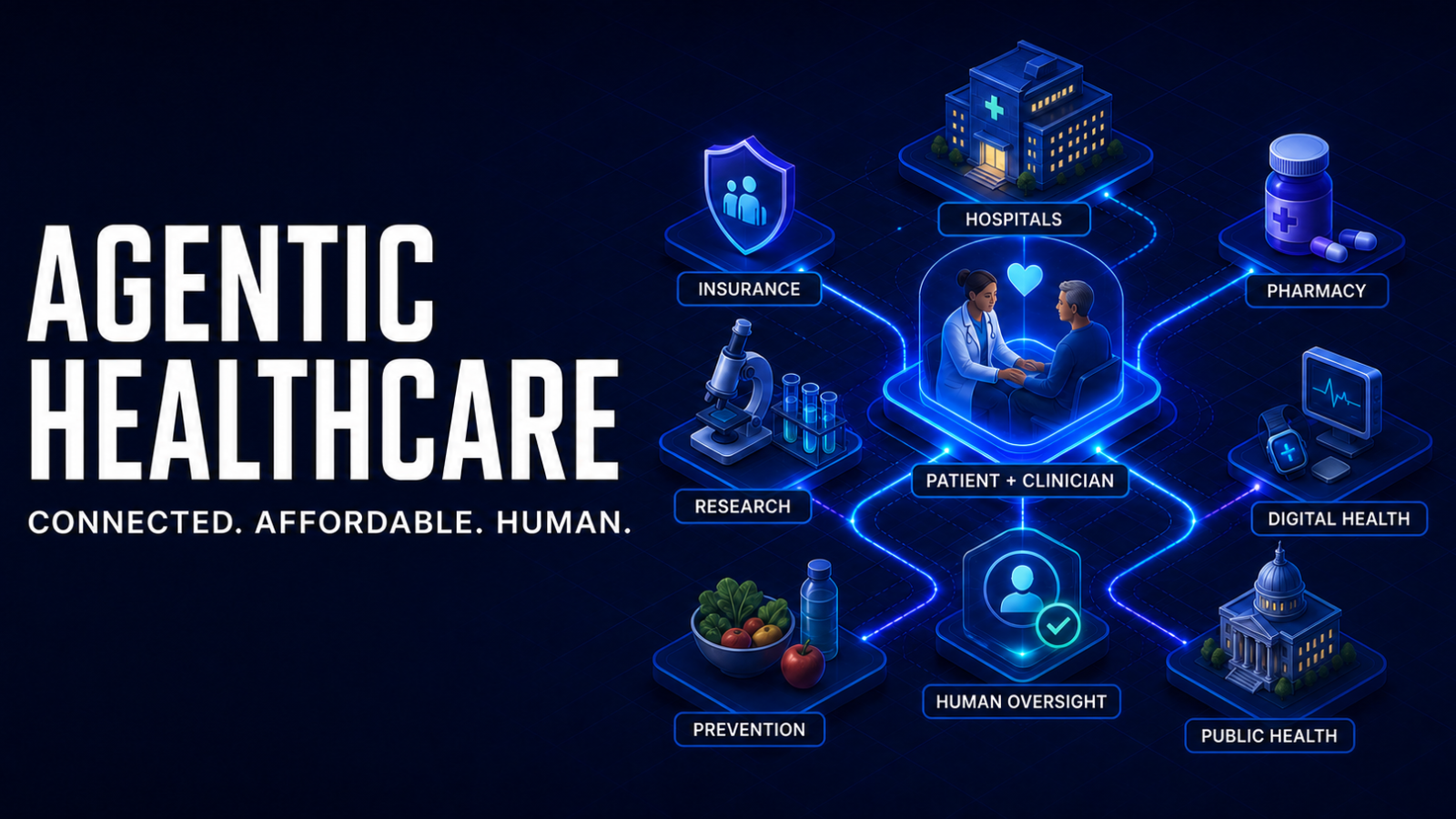
- 2. One health economy, five connected systems
- 3. Where better coordination creates the most value
- 4. What agentic AI changes
- 5. From possibility to practice: agentic AI across the value chain
- 6. The company and product landscape
- 7. Health begins before and between medical encounters
- 8. Food, healthcare, and the social return
- 9. The human and economic return
- 10. Responsible deployment: evidence earns authority
- 11. A practical transition roadmap
- 12. Why healthcare is a global civilizational challenge
- 13. From excellent capabilities to healthier lives
Executive brief
The United States has built one of the world’s most capable health economies: leading biomedical research, advanced hospitals, specialized professionals, innovative medicines and devices, broad public and private financing, and highly productive food and logistics systems. Cancer mortality has continued to decline, and digital infrastructure reaches most hospitals and practices. NCI CMS projects approximately $6.02 trillion in U.S. health spending in 2026, and this article and its companion model use about $6.0 trillion as their single scale baseline. Life expectancy remained 2.7 years below the OECD average, and 27.1 million people were uninsured. CMS projected NHE data, CMS historical and projections data, OECD, Census Bureau
The opportunity is not to replace these strengths, but to connect them. Patients repeat information, clinicians reconstruct context, insurers and providers reconcile different processes, hospitals coordinate complex resources with incomplete visibility, and researchers bridge separate scientific, regulatory, manufacturing, and access systems. Governed agents can maintain a bounded goal across those boundaries: gather permissioned context, use approved tools, complete reversible steps, verify results, and escalate consequential decisions to accountable people.
The most credible early uses are visit preparation, referral closure, authorization, medication reconciliation, results follow-up, discharge, scheduling, supply monitoring, regulatory work, and clinical-trial operations. Early ambient-documentation studies are promising but variable and confirm the need for review. NEJM AI, PHTI The companion model estimates annual base-case value of $9.2 billion at year one, $33.5 billion at year three, approximately $70 billion at year five, and approximately $121 billion at year ten. The year-ten figure represents modeled mature-scale net value created through less waste, more usable care capacity, fewer avoidable costs, and stronger innovation and resilience. It is not a guaranteed spending cut; the larger objective is faster access, safer continuity, less administrative work, reliable supply, and more time for care.
Use agentic AI where fragmented information and unfinished coordination prevent strong people and institutions from delivering their full value. Expand authority only as evidence, accountability, and trust are earned.
1. The next American health advantage
Begin with what America does well
The American health system combines biomedical science, entrepreneurial capital, large-scale manufacturing, advanced hospitals, professional specialization, public programs, and employer-sponsored coverage. NIH directs most of a nearly $48 billion budget through almost 50,000 grants supporting more than 300,000 researchers at more than 2,500 institutions. NIH
Its public foundation is equally important. Medicare, Medicaid, CHIP, VA, IHS, public hospitals, and safety-net organizations provide coverage and care at enormous scale; community health centers alone served 32.4 million people through 139.4 million visits. HRSA America’s productive food and logistics system offers another strong base for healthier choices. Consumers spent $2.58 trillion on food in 2024. USDA Food Dollar
The next advantage is connection. A therapy has limited effect if it cannot be obtained; a test does not improve health if nobody acts on it; and a discharge is incomplete without medicine, equipment, transport, and follow-up. The final mile is how excellence becomes a human result.
The improvement opportunity is measurable
CMS projects health spending to grow 5.4% annually from 2025 through 2034, faster than projected GDP growth of 4.1%, reaching 20.6% of GDP. CBO projects major federal health-program outlays rising from $1.9 trillion in 2026 to $3.1 trillion in 2036. CMS, CBO Growth reflects aging, valuable new therapies, skilled labor, resilience, and better access as well as inefficiency.
The goal is therefore not indiscriminate spending reduction. It is to improve four connected dimensions:
- Spending and price: what care costs and who pays.
- Use and appropriateness: whether services benefit the person.
- Administration and capacity: how much work and infrastructure delivery requires.
- Access and distribution: who receives the benefit and who remains excluded.
A repeated test is a coordination problem; a medication injury is a safety problem; an unnecessary procedure is a clinical and incentive problem; and a low-margin injectable shortage is a manufacturing problem. The often-cited $760–$935 billion waste estimate and CAQH’s roughly $440 billion administrative-workflow estimate are useful taxonomies, not cash pools AI can automatically recover. JAMA, CAQH
The strongest opportunity sits between institutions
Certified EHR technology supports more than 96% of hospitals and 78% of office-based practices, but digitization is not the same as a shared plan. Clinical facts, benefits, pharmacy activity, results, images, bills, evidence, and preferences remain divided across systems. ONC/ASTP
Agentic AI can preserve a task across those boundaries, identify what is missing, direct the next action, verify completion, and escalate exceptions. The productivity test is not how much content it generates; it is whether verified work, delay, error, or risk disappears and the recovered capacity reaches patients and professionals.
2. One health economy, five connected systems
Healthcare is often reduced to a triangle of patient, provider, and payer. That model omits much of what creates health and cost. A more useful map contains five connected systems.
| Connected system | Principal participants | Existing strength | High-value improvement opportunity |
|---|---|---|---|
| Health creation and prevention | people, families, caregivers, food and retail companies, schools, employers, housing, transportation, communities, public health | productive food and logistics networks; extensive preventive knowledge; strong community institutions | make healthy choices, benefits, services, and trusted information easier to access and sustain |
| Coverage, purchasing, and payment | Medicare, Medicaid, private insurers, employers, unions, TPAs, PBMs, brokers, households, regulators | broad public and private financing; sophisticated actuarial and payment infrastructure | make benefits computable, administration simpler, approvals faster, prices clearer, and appeals effective |
| Care delivery | physicians, nurses, pharmacists, clinics, hospitals, laboratories, imaging, EMS, post-acute, home, rehabilitation, behavioral and long-term care | highly trained professionals; advanced acute and specialty care; diverse delivery organizations | coordinate longitudinal care, return attention to relationships, improve flow, and close every handoff |
| Medicines, devices, diagnostics, and physical supply | pharma, biotech, medtech, manufacturers, wholesalers, distributors, pharmacies, GPOs, clinical engineering | global innovation, production, and distribution capability | accelerate qualified evidence, strengthen quality and resilience, and make access part of product performance |
| Knowledge, technology, and governance | universities, NIH, research networks, EHR and cloud platforms, standards bodies, FDA, HHS, states, cybersecurity and capital providers | deep research base, widespread digitization, strong regulatory institutions | connect permissioned data, make policy machine-readable, evaluate outcomes independently, and govern agent authority |
These systems are connected by five flows:
- People and physical goods: patients, workers, medicines, devices, food, specimens, blood, organs, and supplies.
- Money: taxes, premiums, wages, claims, grants, rebates, prices, contracts, capital, and household payments.
- Information: clinical evidence, eligibility, policy, price, quality, inventory, safety signals, and individual context.
- Authority: who may diagnose, prescribe, approve, deny, allocate, regulate, appeal, or stop an automated action.
- Risk and value: who bears clinical, operational, financial, cyber, caregiving, and transition risk—and who receives the benefit.
Following these flows clarifies why seemingly straightforward improvements stall. The organization that pays for better coordination may not receive the avoided expense. A clinic may fund follow-up that prevents a hospitalization paid by an insurer. A hospital may lose fee-for-service revenue after preventing an avoidable admission. A family may absorb unpaid care while formal accounts show no additional cost. A manufacturer may be rewarded for a low unit price but not for redundant capacity or mature quality systems. A technology vendor may earn revenue even when the customer never removes old work.
The flow model also shows where incentives can align. Employers that bear claims risk benefit when navigation improves access and prevents avoidable crises. Health systems operating under accountable payment can benefit from stronger longitudinal care. Public programs can use purchasing power to reward simpler administration, resilience, and measurable outcomes. Manufacturers can compete on supply reliability and total therapeutic performance, not only product price. Shared evaluation can make value visible across organizational boundaries.
Patients and families are participants, not endpoints
People do far more than receive care. They recognize symptoms, provide histories, choose among uncertain options, travel, schedule, pay, administer medicines, monitor recovery, and coordinate between organizations. Families often become an unpaid operational layer, particularly for children, older adults, people with disabilities, serious illness, or multiple chronic conditions.
A better system recognizes patient and caregiver time as a real resource. It asks how many calls, forms, visits, miles, repeated histories, and hours of uncertainty a pathway requires. It measures whether a person understood the plan, obtained the medicine, reached the appropriate professional, and knew where to seek help. It provides accessible human service for people who cannot or do not want to use a digital channel.
Employers and public programs are healthcare operators
Employers are not merely premium payers. In 2025, 67% of covered workers were enrolled in self-funded plans, including 80% at organizations with at least 200 workers. KFF In these arrangements, the employer may bear claims risk while a third-party administrator operates the network and claims, a PBM manages pharmacy benefits, and brokers, consultants, and stop-loss carriers influence the design. These organizations are natural buyers of navigation, benefit explanation, administrative simplification, and specialty-drug coordination. They also need strict separation between health data and employment decisions.
Government programs also operate distinct care and administrative environments. Medicaid combines federal and state financing and covers populations with different needs across states. Medicare operates through traditional coverage, private Medicare Advantage plans, drug benefits, contractors, and providers. VA integrates direct delivery with community care. IHS and tribal health programs operate under particular sovereign, facility, workforce, and data conditions. Correctional reentry programs must coordinate coverage, medicine, behavioral health, and community services at a high-risk transition. An agent designed for one environment should not be copied into another without adapting authority, policy, population, and evidence.
Products have lifecycles, not just launch dates
A medicine moves from biological hypothesis through experiments, candidate selection, preclinical work, clinical trials, regulatory review, manufacturing, distribution, prescribing, coverage, dispensing, adherence, safety monitoring, and continuing evidence. A medical device has a parallel lifecycle involving design controls, validation, procurement, training, maintenance, utilization, complaints, recalls, and replacement. Success at one stage does not guarantee patient benefit at the end.
Only about 12% of drugs entering clinical trials are ultimately approved, according to CBO’s review. Estimated development cost per successful drug varies widely depending on method and assumptions. CBO AI may reduce search and experimental cycles, improve trial feasibility, and help regulatory teams maintain evidence. But a generated molecule is not a medicine, a matched record is not an enrolled participant, and a faster submission is not proof of safety or effectiveness. The unit of value is qualified learning that changes a real decision.
3. Where better coordination creates the most value
The U.S. system does not need a single diagnosis. It needs a focused improvement agenda that distinguishes the work AI can address from the policy, capacity, and physical investment that must accompany it.
2. Return time to patients and professionals
Administrative work is not inherently wasteful. Documentation, eligibility, privacy, payment accuracy, safety, and appeals serve legitimate purposes. The opportunity is to remove duplicate work and adversarial reconciliation. Patients should not spend hours determining who owns the next step. Clinicians should not reconstruct a chart from scattered records. Staff should not repeatedly enter the same data or poll a portal for status.
The best early agents will work quietly: retrieving records, preparing information, drafting from evidence, moving a process through approved tools, and presenting exceptions rather than adding alerts. Their value should be measured in net time after review and correction—not gross minutes saved in one task while work moves elsewhere.
3. Strengthen prevention and chronic-care continuity
CDC reports that people with chronic and mental health conditions account for roughly nine of every ten dollars in annual U.S. health expenditure. This does not mean 90% is preventable. It means a projected $6 trillion health economy must produce health over time, not only during encounters. CDC
Cardiovascular disease, diabetes, kidney disease, cancer, mental illness, substance use, dementia, respiratory disease, and multimorbidity require ongoing medication, monitoring, behavior support, and adaptation. The operational failures are often familiar: a measurement is not reviewed, a medicine is not filled, a laboratory test is overdue, a referral is incomplete, or a change in symptoms does not reach the right professional. A longitudinal agent can maintain that state and make missing action visible while clinicians retain medical authority.
4. Improve affordability and financial clarity
Households experience healthcare cost through premiums, taxes, wages, deductibles, copayments, uncovered services, medicine prices, travel, and time away from work. Even an insured person may not know the likely cost or whether a professional is truly in network until after receiving care.
Agents can explain benefits, retrieve current criteria, estimate patient responsibility from available data, compare covered options, find assistance, and reconcile authorization, claim, and bill. They cannot by themselves change market power, benefit generosity, drug pricing, or public eligibility law. Their role is to make existing rights usable and policy reform easier to administer.
5. Improve safety and complete every handoff
Healthcare is safer when a signal becomes accountable action. In an HHS OIG clinical review of Medicare hospital stays in October 2018, one quarter of patients experienced an adverse event or temporary harm event, and reviewers considered 43% of those events preventable. Medication events were the largest category. The finding applies to that sampled population and period, but it illustrates the continuing opportunity. HHS OIG
A predictive alert alone is not a safety system. The complete loop identifies the responsible person, provides relevant evidence and uncertainty, proposes an approved response, observes whether the response occurred, reassesses the situation, and escalates if necessary. The same design applies to abnormal tests, deteriorating patients, medication discrepancies, infection signals, recalls, and post-discharge risk.
6. Make medicine and device supply more resilient
Advanced care depends on ordinary products being available at the right moment. FDA was tracking 102 drug shortages as of July 31, 2024, including 71 sterile injectables commonly used in hospitals and cancer treatment. GAO FDA has identified low profitability, weak market reward for mature quality systems, and slow recovery after disruption as important causes. FDA
Medical-device supply deserves the same attention. FDA’s June 2026 shortage list included products used in oxygenation, breast biopsy, neurosurgery, and endoscopic vessel harvesting. A listing does not establish patient harm, but it identifies dependencies that operational leaders need to manage. FDA
Agents can connect demand, inventory, manufacturing quality, logistics, substitution rules, utilization, expiration, and local clinical priority. They can identify risk earlier and coordinate conservation or replenishment. They cannot create a missing production line or supplier. Resilience still requires purchasing contracts, quality incentives, redundancy, capital, and transparent risk sharing.
7. Accelerate qualified scientific and operational learning
Biomedical evidence now exceeds what any individual can continuously absorb. Research teams must synthesize literature, integrate complex data, design experiments, activate sites, recruit participants, monitor trials, maintain regulatory documents, and learn from post-market experience. AI can improve each step, especially when it operates through specialized scientific tools and preserves provenance.
The standard is not the number of hypotheses or documents generated. It is the rate of reproducible learning: better experiments, earlier failure of weak candidates, more feasible protocols, representative enrollment, cleaner evidence, faster identification of safety signals, and more effective products reaching appropriate patients. Scientific judgment, participant protection, regulatory accountability, and manufacturing quality remain human and institutional responsibilities.
These seven priorities share a practical pattern. Information exists somewhere, but the responsible participant does not receive it in time, the next action is unclear, or nobody verifies completion. This is the opening for governed agentic AI.
4. What agentic AI changes
“Agentic” should not be a marketing synonym for a chatbot. A reliable healthcare agent maintains a bounded objective across steps, systems, and time: it uses permissioned evidence and approved tools, knows what remains incomplete, verifies the result, and stops when human authority is required.
A referral agent illustrates the difference. Instead of merely creating an order, it can assemble the record, confirm network and availability, obtain patient preferences, request missing information, schedule, monitor acceptance, and return the result to the original team. Denials, delays, and clinical exceptions go to the person authorized to resolve them.
The underlying system may combine deterministic rules, language or predictive models, computer vision, retrieval, optimization, legacy automation, simulation, and specialized scientific tools. The best component may be a rule or optimizer rather than a general model; the agent’s role is to orchestrate the right methods and maintain outcome state.
Nine properties of a useful healthcare agent
The nine properties are a bounded goal, permissioned context, a plan, approved tools, state over time, verification, visible uncertainty, escalation, and accountability. Together they distinguish a system that completed an authorized task from one that merely produced a plausible response.
Authority should match consequence. A scheduler can make reversible changes under clear rules; a clinical-treatment or coverage decision affects rights, health, and finances and requires stronger evidence and an accountable professional or lawful process.
Clinical operations before autonomous medicine
Clinical judgment includes diagnosis, treatment, consent, uncertainty, and preference-sensitive decisions. AI may organize evidence or propose alternatives, but a qualified professional remains responsible. Clinical operations—collecting records, exposing prerequisites, routing tasks, monitoring completion, and escalating exceptions—are a better initial domain for agents.
Frontier research has demonstrated agents working in sandboxed EHR environments, but capability is not proof of readiness for unsupervised care. Nature Near-term deployment should therefore scale broadly across low-risk coordination before expanding consequential authority.
From assistance to verified completion
Authority progresses from retrieving and summarizing, to drafting for review, to executing reversible actions, to completing preapproved workflow steps, and finally to consequential decisions. Most organizations should concentrate on the first three levels.
Deeper authority requires prospective evidence for the exact workflow and population. Technical accuracy alone is insufficient; evaluation must include access, net work, completion, outcomes, equity, and economic return.
5. From possibility to practice: agentic AI across the value chain
Agentic healthcare is most useful when organized around people and outcomes. Identity, consent, longitudinal memory, evidence retrieval, task management, verification, and escalation are reusable; the protocol, authority, and success measure must change with each setting.
People need continuity across life stages
People encounter different risks and institutions across life. A reusable agentic layer can coordinate those transitions without treating maternal care, behavioral health, chronic disease, disability, and serious illness as interchangeable.
| Population or need | Bounded agentic role | Outcome that matters |
|---|---|---|
| Maternal, reproductive, and infant health | maintain a consented prenatal and postpartum plan; coordinate care, transport, benefits, and warning escalation | timely care, safer transitions, respected choice |
| Children and adolescents | reconcile milestones, permissions, medicines, school plans, and care transitions | development, attendance, continuity, family confidence |
| Prevention and primary care | prioritize evidence-based needs and close screening, result, and referral loops | appropriate prevention, earlier detection, less effort |
| Chronic and multiple conditions | reconcile medicines, labs, devices, symptoms, and specialty plans | disease control, fewer crises, simpler self-management |
| Cancer, rare, and complex disease | assemble evidence, coordinate prerequisites, and surface appropriate trials | faster diagnosis and treatment, wider access, fewer repeated tests |
| Mental health and substance use | match services, support follow-up, and follow privacy and crisis protocols | timely trusted care, engagement, safe escalation |
| Disability, rehabilitation, and aging | provide accessible navigation and coordinate equipment, home services, and caregivers | function, independence, participation, sustainable care |
| Serious illness and end of life | retrieve preferences and coordinate symptom, palliative, or hospice support | comfort, dignity, care aligned with goals |
Every pathway still needs clinical and community expertise and a real service capable of responding. An agent can expose a missing maternity unit, therapist, medicine, or home-care service; it cannot replace one.
Give patients and families a coordinated front door
With permission, a personal health agent can assemble a sourced longitudinal record, explain benefits, prepare visits, find appropriate appointments, coordinate referrals, monitor results and medicines, estimate financial exposure, and help correct errors or appeal decisions. Success means fewer hours navigating care, faster access, completed follow-up, and greater confidence—not more digital activity.
Trust requires transparent incentives, data minimization, portability, accessible human service, and no hidden commercial steering. The agent may support navigation and financial protection, but it should not independently diagnose or make adverse eligibility and coverage decisions.
Return clinical attention to the relationship
Care teams spend substantial time reconstructing context, documenting visits, managing inboxes, completing forms, reconciling medicines, and chasing referrals. Ambient documentation provides an encouraging entry point: randomized and pragmatic studies found reduced documentation time or work exhaustion in some settings, with variable results and continued need for clinician review. NEJM AI randomized trial, pragmatic trial
A longitudinal practice agent can prepare the chart, draft sourced documentation, prioritize inbox work, reconcile medicines, assemble authorization evidence, and maintain referrals and abnormal results until completion. The governing rule is one review, one responsibility, and no hidden work: AI should remove net work rather than create longer notes, correction burden, or new alerts.
Primary, specialty, pharmacy, behavioral, dental, vision, rehabilitation, and home-care workflows require different evidence and controls. In every case, diagnosis, treatment, consent, and relationship remain with accountable professionals and patients.
Help hospitals operate as one real-time system
Hospitals coordinate staffed beds, tests, consultations, procedures, medicines, supplies, transport, environmental services, discharge, and external care capacity under uncertainty. Emergency-department boarding shows how a delay anywhere can affect the whole system and patient safety. AHRQ
An operations agent can maintain the shared state of admissions, beds, surgery, diagnostics, pharmacy, equipment, and post-acute acceptance. In surgery, it can identify missing prerequisites and cancellation risk. In laboratories and imaging, it can connect detection to accountable follow-up. The objective is safe care, fair prioritization, and sustainable workload—not throughput alone.
At discharge, the agent can verify medicines, equipment, education, transport, follow-up, and acceptance by the next team. Physical infrastructure—utilities, sterile processing, maintenance, and downtime capability—remains part of safe capacity and still requires trained people and investment.
Make coverage easier to understand and use
A governed payer or provider agent can retrieve current benefits, assemble an authorization packet, process bounded claims, explain status, and prepare an appeal. It should approve clearly qualifying requests before escalating exceptions and should measure time to appropriate care, accuracy, rework, affordability, and member experience.
Automation must not become an opaque denial channel. CMS guidance states that algorithms may support Medicare Advantage coverage decisions but cannot replace required individualized assessment. CMS Adverse action requires current policy, individual facts, an accountable decision-maker, a specific reason, and meaningful recourse.
Connect pharmacy access to therapeutic success
A prescription creates value only when the medicine is appropriate, covered, affordable, available, safely dispensed, understood, and monitored. An agent can reconcile the medicine list, assemble coverage evidence, locate supply, coordinate support and administration, and confirm the first safe dose and follow-up.
Pharmacists retain dispensing accountability, clinical intervention, substitution judgment, and counseling. Automation should reduce calls, status chasing, and duplicate reconciliation while making benefit and channel incentives visible.
Improve the medicine and device lifecycle
Scientific and development agents can synthesize evidence, use qualified tools, record experiments, test protocol feasibility, support trial operations, and maintain regulatory state. AI is already being explored across drug development, but value must be measured through reproducible learning, representative trials, qualified evidence, and effective products—not generated hypotheses or documents. Nature Medicine
Post-market agents can connect reports, clinical data, product lots, complaints, and exposure for expert review. Device and supply agents can link procurement, training, maintenance, quality, inventory, shortages, recalls, and replacement. Scientists, investigators, participants, regulators, quality teams, pharmacists, and clinicians retain authority.
Turn research and data infrastructure into a learning network
EHR, claims, pharmacy, laboratory, imaging, device, registry, and research systems each hold part of the picture. The goal is not to centralize everything, but to make the minimum necessary context available for an authorized purpose with provenance, explicit delegation, and revocation.
As agents gain the ability to act, identity, least-privilege tools, transaction limits, monitoring, downtime capability, and independent evaluation become essential. The Change Healthcare cyberattack demonstrated how disruption at one platform can affect national claims and cash flow. GAO
Fifteen priority workflows
The full model evaluates 28 workflows. This reader-oriented portfolio keeps the 15 most representative categories and the measure that should govern each one.
| Priority workflow | Agent completes | Success measure |
|---|---|---|
| Personal health navigation | records, benefits, appointments, tests, medicines, follow-up | time to care, patient time, closed loops |
| Prevention and chronic-care coordination | care gaps, home data, labs, medicines, exceptions | appropriate completion, control, burden |
| Maternal and child pathways | longitudinal plan, warning escalation, transport, family coordination | response, continuity, safety |
| Behavioral-health navigation | service matching, warm handoff, follow-up, crisis escalation | access, engagement, safe escalation |
| Visit preparation and documentation | sourced brief, draft note, instructions, pending work | net time, accuracy, understanding |
| Inbox, results, and referral closure | triage, delegation, acceptance, result-to-plan tracking | turnaround, completion, escalation accuracy |
| Medication management and pharmacy access | reconciliation, coverage, supply, monitoring, first dose | time to therapy, discrepancies, safety |
| Hospital flow and discharge | bed, test, consult, transport, equipment, post-acute state | boarding, safe delay, readmission, workload |
| Surgical and procedural readiness | authorization, preparation, staff, room, device, follow-up | cancellations, delay, safety |
| Authorization, claims, and appeals | policy, evidence, transaction, status, reason, recourse | time to care, accuracy, rework |
| Public-program administration | enrollment, renewal, notices, service and case state | coverage, processing time, error |
| Supply and device lifecycle | demand, inventory, quality, maintenance, shortage, recall | shortage days, expiry, downtime |
| Discovery and scientific operations | evidence, tool use, experiment state, reproducible record | validated learning, reproducibility, cycle time |
| Trial and regulatory operations | feasibility, matching, site, data, and submission state | enrollment, inclusion, quality, safety |
| Post-market safety | signal enrichment, lot and exposure linkage, investigation state | time to qualified signal and action |
Three journeys show how the pieces connect
Chronic care. With consent, an agent prepares visits, reconciles medicines, follows tests and referrals, and makes meaningful exceptions visible to the clinician. The patient receives one understandable plan and less navigation work; success is better control with fewer crises and fewer unnecessary contacts.
Surgery. The agent maintains readiness across authorization, testing, preparation, staff, room, device, bed, transport, and follow-up. It identifies missing dependencies early and supports safe discharge; the surgical team retains clinical authority.
Therapy development. Scientific, trial, regulatory, manufacturing, and safety agents maintain traceable work across the product lifecycle. Accountable researchers and regulators approve consequential decisions; success is faster, more reproducible learning and timely access to a safe, effective product.
Across all three, the agent coordinates information and action while people and institutions retain judgment, physical care, resources, and accountability.
6. The company and product landscape
The health-AI market spans workflow software, care navigation, operations, diagnostics, research, and infrastructure. U.S. digital-health startups raised $14.2 billion across 482 deals in 2025, while a 2026 peer-reviewed analysis identified 3,807 AI health startups founded from 2010 through 2024. Funding shows commercial momentum, not clinical proof. Rock Health, npj Digital Medicine
The landscape is best understood as a stack. The companies below are representative rather than exhaustive or endorsed, and many operate across more than one layer.
| Layer or workflow | Representative companies | What they show |
|---|---|---|
| Clinical documentation and workflow | Abridge, Ambience, Suki, Nabla, Microsoft Dragon Copilot | documentation is the leading adoption wedge and is expanding into orders, inboxes, and workflow |
| Patient communication and navigation | Hippocratic AI, Infinitus, Hyro, Transcarent, Included Health | persistent, multilingual service can connect benefits, providers, and follow-up |
| Authorization, coding, and payment | Cohere Health, Anterior, AKASA, CodaMetrix, Waystar | language-rich policy, evidence, coding, and transaction work can be streamlined |
| Health-system data and operations | Innovaccer, Qventus, LeanTaaS, Epic, Oracle Health | data platforms can orchestrate capacity, surgery, flow, and enterprise agents |
| Imaging, diagnostics, and precision medicine | Aidoc, Viz.ai, PathAI, Tempus, Flatiron Health | bounded AI signals can trigger clinical coordination and connect care with research |
| Evidence and scientific data | OpenEvidence, Benchling, Dotmatics, NVIDIA BioNeMo | clinical knowledge and laboratory data need retrieval, tools, provenance, and reproducibility |
| Discovery and computational biology | Isomorphic Labs, Recursion, Insilico Medicine, Schrödinger, Chai Discovery | models can expand scientific search and prioritize experiments |
| Trial design and execution | Medable, Unlearn, Formation Bio, Deep 6 AI, ConcertAI | AI can support feasibility, matching, decentralized operations, and trial data workflows |
Incumbents are economic control points, not background infrastructure
The market sits inside a larger corporate and technical structure. Insurers may own PBMs, pharmacies, and provider assets; health systems own practices and ambulatory sites; distributors combine logistics, purchasing, oncology, and prescription technology; and EHR, clearinghouse, cloud, CRO, and diagnostic platforms control critical handoffs. CVS and McKesson illustrate how care, financing, pharmacy, distribution, and technology can converge inside large enterprises. CVS Health, McKesson
For buyers, the durable questions are straightforward: who owns the workflow and outcome; what the product may read, recommend, or transact; how it is paid; what evidence supports it; and whether data, logs, and operating state remain portable. Integration creates distribution and value, but it can also create steering, dependency, or conflicts that governance must make visible.
The startup opportunity is at the broken edge
The strongest startups will own a measurable handoff rather than sell intelligence in isolation. Durable advantages come from domain expertise, permissioned workflow data, trusted distribution, reliable integrations, outcome measurement, security, regulatory capability, and model or vendor portability.
High-value spaces remain in patient-controlled navigation, disability and caregiver support, Medicaid case completion, rural transport and referral networks, post-acute transitions, supply resilience, shared operations for small practices, independent agent evaluation, and identity, consent, delegation, and action provenance. The companion company diligence register provides the broader research view.
7. Health begins before and between medical encounters
Medical care is indispensable, but food, housing, education, work, transportation, environment, public safety, social connection, and income shape both risk and the ability to follow a care plan. HHS Healthcare organizations cannot solve every social problem, but they should recognize when an unaffordable meal, missed ride, or unavailable home service prevents care from working.
Prevention should be justified first by better health. Some interventions save medical spending; others create health at an additional cost, and the organization that invests may not receive the later benefit. Fiscal return should therefore be measured rather than assumed.
Build on the strengths of America’s food system
America combines abundant agriculture, advanced food science, efficient logistics, widespread distribution, and substantial choice. The opportunity is to make nutritious, culturally appropriate food easier to afford and use. In 2024, 13.7% of U.S. households experienced food insecurity; in 5.4%, eating patterns were disrupted and intake fell at times. USDA A small NIH randomized trial also found that adults consumed more calories and gained weight during a two-week ultra-processed diet phase, a useful controlled result that should not be generalized to every processed food or lifetime outcome. PubMed
With consent, agents can simplify nutrition-benefit enrollment, personalize options around budget and culture, support healthier institutional procurement, forecast demand, and verify that food support was fulfilled. AI improves coordination; income, benefit adequacy, product design, retail access, transport, and public policy remain the structural levers.
Support behavior without moralizing
Tobacco, alcohol, activity, sleep, stress, and social connection occur within addiction, products, environments, relationships, pain, and economic pressure. A useful agent helps a person choose a goal, understand options, obtain covered support, and reach a professional when risk rises.
Public-health agents can identify service gaps, support multilingual outreach, and measure reach. They should not create hidden behavioral profiles for employment, insurance selection, marketing, or law enforcement.
Strengthen vaccine evidence and trust
Vaccines have benefits, contraindications, common reactions, rare serious adverse events, manufacturing requirements, and continuing surveillance. The correct unit of analysis is the specific vaccine, population, and outcome. VAERS is an early-warning system and generally cannot determine causality by itself; signals require comparison data and expert study. FDA
AI can enrich reports, link product and timing, analyze active-surveillance data, prioritize expert review, check contraindications, and communicate known benefits, risks, and uncertainty. Trust comes from open methods, timely investigation, correction, accessible explanation, and respect for informed choice.
Treat prevention as a coordinated service
Agents can connect public health, primary care, schools, employers, pharmacies, community organizations, and households around a clear outcome: identify an evidence-based need, arrange the service, resolve practical barriers, monitor the result, and return the plan to the accountable professional.
This is a positive agenda—using America’s food, scientific, public-health, and delivery capabilities to help people remain healthy, functional, and independent for longer.
9. The human and economic return
Agentic healthcare creates different forms of value, and a gain for one organization may be a transfer from another. A responsible model distinguishes:
- Cashable savings: an expense actually disappears after implementation and operating costs.
- Usable workforce or asset capacity: time, beds, rooms, equipment, or inventory become safely available.
- Avoided medical expenditure: a causal improvement prevents unnecessary or harmful care, not needed service.
- Research and resilience value: qualified learning and continuity improve without counting speculative sales.
Health, function, time, financial protection, agency, trust, and equity remain a separate human ledger rather than being forced into one dollar estimate.
A cautious, driver-based scenario
The companion model applies adoption, performance, realization, outcome, cost, transfer, overlap, and evidence assumptions to 28 workflows instead of multiplying the projected $6.017 trillion 2026 total by a general savings percentage. Inputs are available in the updated workbook and methodology.
| Horizon | Conservative | Base | High | Base vs projected 2026 NHE |
|---|---|---|---|---|
| 1 year | $3.7B | $9.2B | $18.4B | 0.15% |
| 3 years | $13.6B | $33.5B | $67.0B | 0.56% |
| 5 years | $28.3B | $70.0B | $140.2B | 1.16% |
| 10 years | $49.1B | $121.4B | $243.6B | 2.02% |
The Year 5 figures apply a uniform 2.99% prudence adjustment to that horizon’s workflow-adoption assumptions; Years 1, 3, and 10 are unchanged. The $121.4 billion year-ten base case is an annual value pool in constant 2024 dollars. It describes the modeled net value created by mature agentic-AI adoption through four economic pathways:
- Less waste — $55.47B: potentially cashable value that can lower operating costs, premiums, and public-program pressure or be reinvested.
- More healthcare capacity — $37.67B: usable workforce and asset capacity that can help clinicians and facilities serve more patients, reduce overtime, and improve workforce retention.
- Fewer avoidable costs — $12.21B: avoided medical expenditure that can free household, employer, insurer, and government resources for other productive uses.
- More innovation and resilience — $16.08B: research, operational, and supply-chain value that can support R&D, digital infrastructure, reliable supply, and faster product development.
The total is not all cash and is not a spending reduction, vendor forecast, or government budget score. Capacity becomes economic value when it produces more care, shorter waits, lower overtime, retained workers, or other measurable output. If organizations reinvest 25%–50% of the potentially cashable portion, that would provide approximately $13.9–$27.7 billion annually for workforce development, clinics, technology, cybersecurity, and research. Such reinvestment can support new and redesigned jobs while strengthening care delivery and innovation. Administrative value emerges earliest; clinical, preventive, supply, and scientific value grows as evidence and physical response capacity mature.
The percentage column uses the projected $6.017 trillion 2026 denominator throughout. Because the CMS projection is in current dollars while the modeled value is stated in constant 2024 dollars, the percentages are scale comparisons—not inflation-adjusted savings rates.
For context, an NBER paper estimated $200–$360 billion in annual savings from wider AI adoption, while a 2026 systematic review found the economic evidence too limited and heterogeneous to support aggregate claims in the hundreds of billions. NBER, Health Policy The model should therefore be treated as an auditable portfolio scenario.
Apply the transfer test
Before counting value, ask: Who gained, who paid, and did the person receive a better result?
- Payment or coding changes are social value only when they reduce rework or improve appropriate care—not when money merely moves between parties.
- Avoided unnecessary care and safe transitions can create value; denied needed care or unpaid risk shifted to families creates harm.
- Better enrollment may increase public spending, and supplier revenue becomes social value only when the product improves an outcome after total cost.
Benefits accrue differently across the system
| Stakeholder | Primary benefit | Condition for durable value |
|---|---|---|
| Patients and families | faster access, clearer plans, financial protection, less navigation work | consent, accessibility, portability, no hidden steering, human recourse |
| Clinicians and care teams | better context, fewer lost handoffs, less rework, more care capacity | old work is removed and professional authority remains clear |
| Clinics and hospitals | stronger flow, safety, continuity, asset use, and payment accuracy | ROI includes patient outcome and total cost, not only volume |
| Payers and employers | simpler administration, better service, payment accuracy, avoidable-use reduction | no opaque adverse action or employment use; gains are shared |
| Medicare, Medicaid, and government | service capacity, program access, payment accuracy, public-health value | program validation, due process, reporting, appropriate reinvestment |
| Pharmacies and supply organizations | faster therapy, fewer shortages, lower rework and downtime | quality and resilience are rewarded; incentives are transparent |
| Pharma, biotech, medtech, and research | reproducible science, stronger trials and safety learning, better capital allocation | evidence standards remain intact; speculative value is excluded |
| Technology companies and startups | a market for trusted workflow and infrastructure products | outcome evidence, portability, incident disclosure, fair pricing, safe exit |
The model allocates $19.2 billion of year-ten base financial or service-capacity value to federal programs and $10.9 billion to state and local government. The combined $30.1 billion is not automatic deficit reduction: better access may appropriately increase care, and capacity may be reinvested in service, prevention, cybersecurity, or research.
AI can also help government administer payment and policy, but it should not be credited with the full value of reform. For example, GAO estimated $141 billion in ten-year Medicare savings from aligning certain site-of-service payments; AI may support implementation, but the value comes from policy. GAO
The human dividend is the real objective
Economic accounts omit caregiver work, pain, uncertainty, travel, time on hold, lost independence, interrupted education and careers, and reduced participation. Every implementation should therefore report:
- survival, safety, health, and function;
- access, continuity, and financial protection;
- patient and caregiver time, agency, privacy, and trust;
- workforce burden and usable capacity; and
- distribution across the populations material to the workflow.
The pathway is the unit of proof: did the person reach appropriate care, receive the medicine, understand the plan, and experience less burden? Low-cost, persistent coordination can broaden support while reserving scarce human attention for relationship, judgment, empathy, and physical care.
11. A practical transition roadmap
Agentic healthcare should develop as an operating transformation, not a collection of pilots. Authority and scale should advance with evidence, shared infrastructure, and institutional cooperation.
Year 1: prove that verified work disappears
Begin with a few bounded, observable workflows such as visit preparation, documentation, referrals, authorization packets, scheduling, medicine reconciliation, discharge prerequisites, inventory visibility, or research search. Establish the baseline for time, error, delay, workload, cost, and access before deployment.
Redesign the workflow, limit authority, compare it with usual practice, and ask one question: which verified work, delay, or risk disappeared, and where did the recovered capacity go?
Year 3: connect institutional workflows
Connect related workflows inside organizations and with selected partners: visits with referrals and pharmacy, surgery with beds and discharge, benefits with computable authorization rules, and supply with quality signals. Shared identity, consent, delegation, monitoring, and incident standards should replace isolated departmental bots. Smaller and safety-net providers need shared infrastructure so access to these capabilities is not limited by scale.
Year 5: redesign roles, payment, and regional operations
Convert recovered time into access, safer staffing, less overtime, or stronger continuity. Payers and public programs should share administrative gains, support prevention and home care, and reward resilient supply rather than unit price alone.
Design workforce change by task: professionals retain judgment, relationship, teaching, and physical care while agents reduce search, drafting, status chasing, and reconciliation. Organizations should state which tasks end, how people are trained or redeployed, and how work intensification will be prevented.
Year 10: build a governed learning health network
The long-term objective is a federated network—not one national agent. Authorized agents should retrieve necessary evidence, use interoperable tools, carry permissioned goals, keep referrals and transitions visible, support real-time operations, and create verifiable transaction records across institutions.
Coverage remains contestable, science remains reproducible, and public agencies can evaluate access, outcomes, cost, and distribution. Consequential authority still advances more slowly than capability; the network makes accountability portable rather than removing responsible people.
What each leader can do now
Federal and state governments should make policy computable, establish identity and incident standards, modernize administration with appeal rights, and fund independent evaluation.
Health systems and clinics should create cross-functional governance and begin with a small portfolio of documentation, referral, medication, discharge, capacity, and supply workflows.
Payers and employers should publish current criteria, automate approval before denial, protect health data from employment use, and share gains with members and providers.
Pharmacies, pharmaceutical, biotechnology, and medical-device companies should connect access, safety, manufacturing, supply, and evidence while measuring reproducibility and validated progress.
Universities and research organizations should provide permissioned research environments, workforce training, and independent evidence.
Technology companies should design for bounded roles, provenance, portability, safe failure, measurable outcomes, and responsible exit.
Patient, disability, caregiver, and community organizations should shape objectives, accessibility, consent, appeal, evaluation, and the distribution of gains.
A Health Outcomes and Capacity Compact
The transition needs a shared scorecard covering access and outcomes; safety and recourse; patient, caregiver, and workforce time; total cost and financial protection; and equity, accessibility, trust, and resilience. Productivity gains should support patient-facing time, sustainable staffing, prevention, cybersecurity, independent evaluation, and lower burden—not simply higher quotas or vendor surplus.
12. Why healthcare is a global civilizational challenge
Healthcare is not the world’s only great challenge, but it is one of the principal systems through which poverty, aging, conflict, climate stress, inequality, and scientific progress become human outcomes. WHO and the World Bank estimate that 4.6 billion people lacked full coverage of essential health services in 2023 and 2.1 billion experienced financial hardship from out-of-pocket spending in 2022. WHO–World Bank
The U.S. experience matters because it combines extraordinary science and capital with complex financing and fragmented delivery. Its lessons can travel, but its technology stack should not be copied unchanged. In many countries, the highest-value agents may run on ordinary devices and support community health workers, maternal and primary care, medicine supply, disease surveillance, and public-service navigation. Design must reflect local language, culture, connectivity, clinical authority, data sovereignty, and service capacity. World Bank
Global value should be measured in service coverage, financial protection, workforce reach, medicine availability, maternal and child health, chronic-disease control, resilience, and local capability—not by multiplying the U.S. financial scenario by GDP. WHO guidance likewise emphasizes public-interest infrastructure, human rights, independent audit, and risk-proportionate governance. WHO The common objective is to extend healthy function and make care accessible without financial ruin.
13. From excellent capabilities to healthier lives
America has already built many capabilities required for a better health future: outstanding science, advanced care, innovative companies, broad financing, a productive food system, experienced regulators, digital infrastructure, and millions of skilled people. The next advantage is connection—so patients do not carry every message, clinicians do not reconstruct information that already exists, and institutions can see the constraints blocking safe care, therapy, research, or supply.
Agentic AI can maintain those goals across time, data, tools, and organizations; perform reversible work; verify completion; and bring consequential exceptions to responsible people. The modeled financial opportunity is meaningful but not automatic. The larger return is earlier care, safer transitions, understandable coverage, reliable medicines and supplies, sustainable professional work, supported caregivers, and more healthy years.
The purpose is not automation for its own sake. It is to make an already remarkable set of capabilities work better together. That is the promise of agentic healthcare: not healthcare without people, but healthcare that gives people and professionals more power to create health.
Research notes
Claims in this executive edition use clear evidence boundaries. “Observed” figures are reported by a defined source; “estimated” figures are institutionally derived; “modeled” figures are scenarios calculated from disclosed inputs; and company or workflow examples illustrate activity rather than prove outcomes.
This article is an editorial and scenario analysis. It is not a clinical guideline, legal opinion, actuarial certification, product endorsement, investment recommendation, formal government budget score, or externally peer-reviewed systematic review.